A distributor cannot approve an open-well panel from its horsepower label alone, especially when a product is called 3HP but its stated range ends at 1.5HP. By checking the electrical ratings, motor construction, starting demand, protection functions, enclosure, and supporting documents, you can determine whether a panel is suitable for a particular pump and compare suppliers on evidence rather than marketing terms.
Key takeaways
- Reject specifications that list horsepower without voltage, current and motor type.
- Confirm a 3 HP panel’s maximum current matches the pump nameplate.
- Use open-well panels for surface-accessible water sources, not bore-well installations.
- Request capacitor ratings, protection functions, wiring details and test records.
What a Complete Open-Well Panel Specification Must Show
A distributor should reject any single-phase open-well panel specification that gives only horsepower. A complete record must state the supply voltage, permissible voltage range, frequency, maximum motor current, motor type, and whether the design uses capacitor-start/capacitor-run or permanent-split-capacitor operation. “Eco” is a commercial label, not a protection class.
- Require the wiring diagram, bill of materials, terminal schedule, and identification-label layout.
- Record the MCB or short-circuit device rating, contactor rating, overload adjustment range, terminal capacity, and capacitor capacitance, voltage rating, and duty.
- Confirm enclosure material, IP rating, dimensions, mounting method, incoming and outgoing cable-entry sizes, and cable-clamping arrangement.
- Ask for a routine functional-test record covering switching, overload operation, capacitor connection, and indicator or control functions.
- Provide cable length, conductor material, installation method, and supply voltage so the supplier checks starting voltage drop, not just running voltage.
| Specification area | Details to compare | What failure it prevents |
|---|---|---|
| Electrical | Voltage, frequency, operating range, maximum current, MCB, contactor, overload range, capacitor values | Overheating, nuisance tripping, failed starting |
| Mechanical | Enclosure material and IP rating, dimensions, cable entries, terminals, mounting | Water ingress, loose connections, difficult installation |
| Documentation | Schematic, BOM, terminal schedule, labels, test record, applicable test standard | Unverifiable claims and unsafe field wiring |
A distributor searching for a single phase open well eco panel for specifications in coimbatore should demand these records before listing it or placing an order. The panel’s horsepower label cannot replace them.
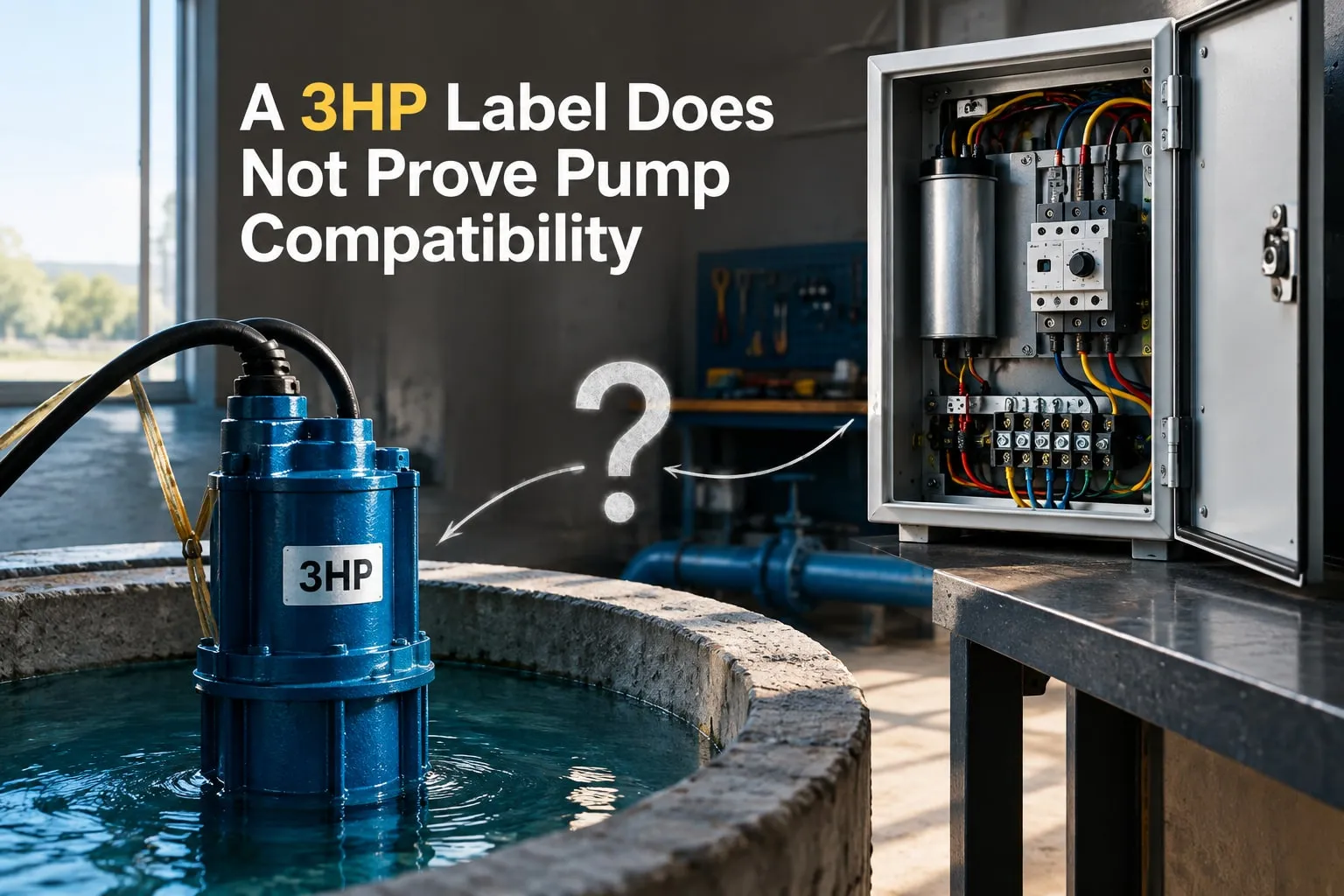
Does a Panel Called 3HP Actually Support a 3HP Open-Well Pump?
A “3 hp” label does not prove that the panel can run a 3 HP open-well motor. It may identify a model family, a component’s maximum rating, or a rating used for another pump application.
If the specification lists its single-phase open-well range only up to 1.5 HP, treat that as the applicable limit until the supplier confirms 3 HP operation in writing.
Match the panel to the pump nameplate and motor data, not to the large number on the cabinet:
- Confirm the motor rating is 3 HP, the supply is single-phase, and the voltage and frequency match the panel.
- Compare the nameplate full-load current with the panel’s maximum motor current and overload-adjustment range.
- Obtain the motor’s starting-current requirement; a 3 HP single-phase motor can draw several times its running current.
- Match the required start and run capacitor capacitance, voltage rating, duty, and connection.
- Confirm the motor type and whether the panel’s contactor, MCB, overload relay, and capacitor arrangement suit it.
A nameplate showing 3 HP alone is insufficient. A panel that matches running amperes but cannot handle starting current can nuisance-trip, overheat, or produce a severe starting voltage drop. Check cable length, conductor material, installation method, and supply voltage as well, because these determine starting performance.
For a 3 hp open well pump panel, request written confirmation that the exact pump model—not merely its horsepower—is supported.
Open-Well and Bore-Well Panels: Which Pump Installation Does Each Serve?
A panel is not interchangeable between open-well and bore-well installations. The pump’s shape, cooling method, cable route, and installation environment determine the correct application.
| Installation feature | Open-well submersible system | Bore-well submersible system |
|---|---|---|
| Pump construction | Compact pump-motor unit for placement in a wide sump or open well | Slim, usually multistage pump-motor assembly sized to fit a drilled casing |
| Water source | Open well, collection sump, tank, or reservoir with accessible water surface | Deep bore casing with water entering through screened sections |
| Cable arrangement | Flexible submersible cable leaves the pump and runs toward the panel, protected from abrasion | Cable runs alongside the rising pipe, secured with cable guards and kept clear of the casing wall |
| Installation conditions | Pump rests or hangs in an open chamber and needs clearance from silt and walls | Pump hangs below the water level inside a narrow casing; removal requires lifting the pipe string |
| Enclosure need | Outdoor pump-house exposure demands an enclosure rated for dust and water under IEC 60529 | The panel also needs suitable environmental protection; an indoor open board is not weatherproof |
| Earthing | Provide a protective-earth terminal and bond the enclosure and motor earth conductor or armour | Use the same protective-earth path through the panel and motor cable; never join neutral to earth casually |
Do not size either system by horsepower alone. Give the supplier:
- Motor full-load current, cable length, conductor material, installation method, and supply voltage.
- Starting-current information, because starting voltage drop can exceed running voltage drop.
- The required dry-run method: current underload, electrode, float, pressure, or level sensor. Each has different installation limits.
How Capacitors, Starting Current, and Protection Functions Affect Selection
Match the start capacitor and run capacitor to the motor nameplate, not to the panel’s horsepower label. Record capacitance in microfarads, voltage rating, duty type, connection, and replacement part number in the open well eco control panel details.
A wrong start capacitor causes humming, slow acceleration, repeated tripping, or failure to start; a wrong run capacitor raises current and motor temperature.
Starting current can be several times full-load current. Check the pump’s starting requirement, cable length, conductor material, installation method, and supply voltage before approving a panel. A panel selected only for running amps can nuisance-trip or create excessive starting voltage drop.
| Protection | What it detects | Selection limit |
|---|---|---|
| Overload relay | Sustained excess motor current | Set from the motor’s full-load current; it will not clear a short circuit |
| MCB or fuse | Short circuit and severe fault current | Confirm breaking capacity and coordination with the contactor |
| Dry-run or undercurrent | Reduced load from loss of water | It can miss partial dry running, fluctuating loads, or a wrongly set threshold |
| Under/over-voltage relay | Supply outside its set range | It cannot correct poor supply or undersized cable |
| Locked-rotor function | Motor that remains at starting current | It cannot repair a seized pump or failed capacitor |
| Phase-failure protection | Usually a three-phase fault | A single-phase panel cannot provide phase-failure protection in that sense |
| Frequent-start protection | Excessive starts within a time period | It limits cycling; it does not replace a correctly sized capacitor or overload setting |
What Should You Request From a Single-Phase Open-Well Panel Supplier?
Request the documents that turn “eco” into a verifiable specification: a wiring diagram, terminal schedule, bill of materials, routine test record, and installation sheet. “Eco” is a commercial label, not a protection or enclosure category.
Ask the single phase open well panel supplier to state nominal voltage, frequency, permissible voltage range, maximum motor current, and the applicable test standard.
- Record MCB rating, contactor rating, overload adjustment range, start and run capacitor values, terminal capacity, conductor sizes, and incoming/outgoing cable-entry dimensions.
- Require enclosure material and IP rating under IEC 60529; an indoor open-board unit is not equivalent to a weatherproof outdoor enclosure.
- Request test evidence showing insulation, earth continuity, control operation, overload trip, short-circuit protection, meter accuracy where fitted, and motor starting.
- Provide pump horsepower, nameplate full-load current, voltage, frequency, motor type, capacitor requirements, cable length, conductor material, installation method, and supply voltage.
- Obtain written confirmation that the panel suits a capacitor-start/capacitor-run or permanent-split-capacitor motor, not merely the stated horsepower.
| Document | Ask the supplier for | Comparison value |
|---|---|---|
| Wiring | Schematic and terminal schedule | Reveals control logic and connection points |
| Components | Ratings and manufacturer references | Exposes undersized MCBs, contactors, or terminals |
| Installation | Mounting, cable entry, earthing, and IP instructions | Prevents unsafe outdoor placement |
| Testing | Dated routine functional test record | Shows the supplied unit was actually checked |
For a distributor evaluating MAG STARTERS (PRAVIN ENGINEERING) - 08048068970, these records provide a fair basis for confirming whether the quoted open-well panel matches the pump and installation.
Related product
 | Submersible Control Panel Single Phase Open Well Eco Control Panel 3HP ₹2000 Features: Ranging from 0.5 HP to 1.5 HP Suitable for Open-well Submersible Pumps With Run Capacitor MCB for Safe Tripping in Short-circuit Housed in... |
Frequently asked questions
What must a complete single-phase open-well panel specification show?
It must state supply voltage, permissible voltage range, frequency, maximum motor current, motor type, capacitor arrangement and protection functions.
Does a panel labelled 3 HP support every 3 HP open-well pump?
No. Match the panel’s maximum motor current, starting-current capability, voltage and capacitor design with the pump nameplate and motor type.
What is the difference between an open-well and bore-well panel?
An open-well panel serves pumps installed in accessible wells or water bodies, while a bore-well panel is designed for submersible pumps installed inside narrow boreholes.
What should you request from a single-phase open-well panel supplier?
Request a detailed datasheet, wiring diagram, current rating, voltage range, capacitor values, protection settings, enclosure details, test records and warranty terms.
Keywords