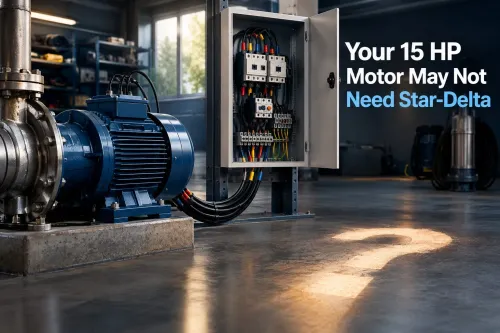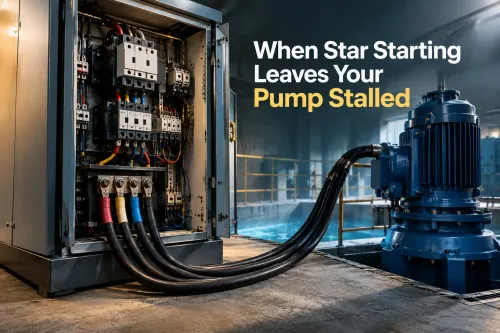
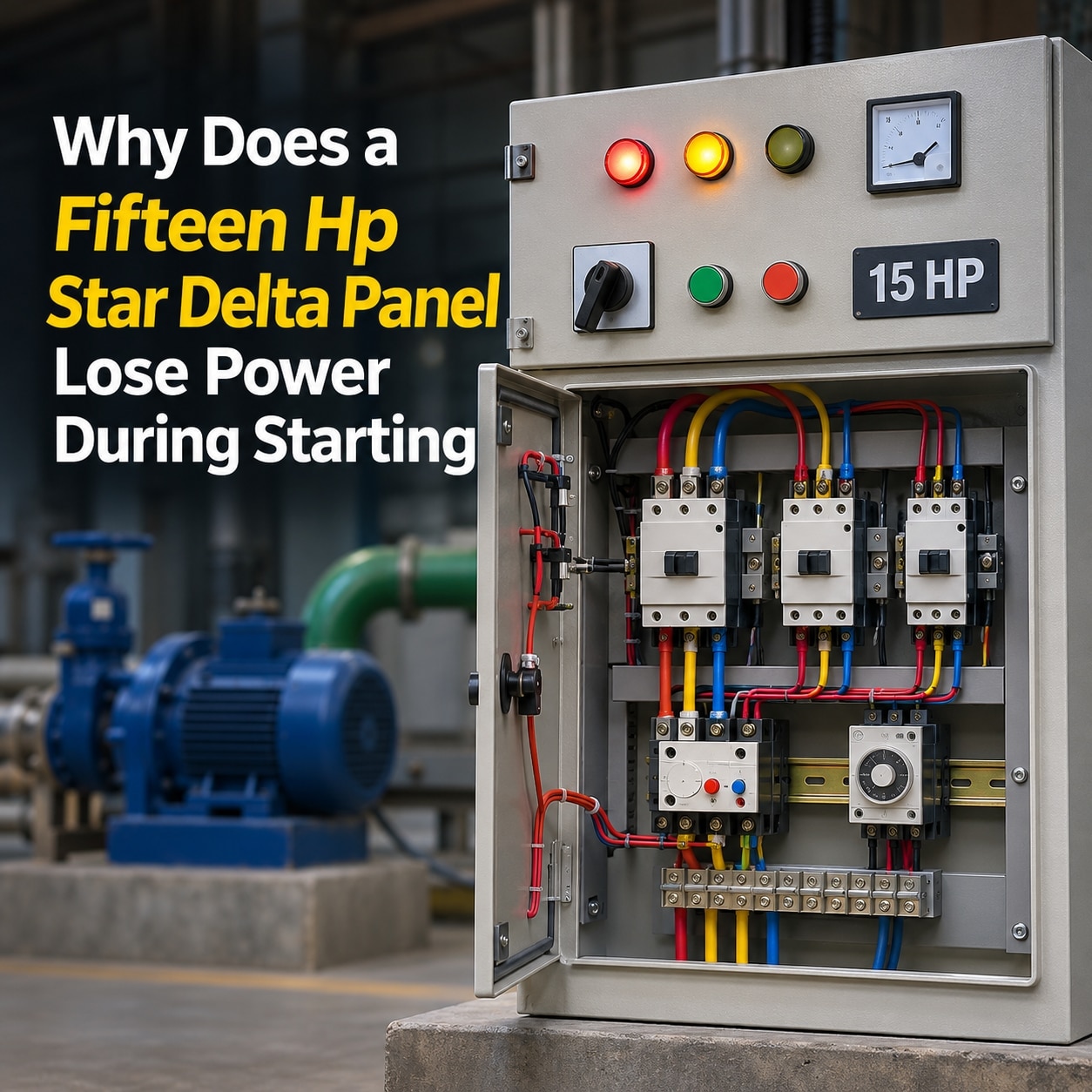
A fifteen hp motor that goes dead during starting has not necessarily lost utility power. The fault may be a missing phase, voltage collapse under load, contactor dropout during star-to-delta changeover, control-circuit failure, or a pump that cannot accelerate at reduced star torque. By the end, you will have a measurement sequence that separates these causes before anyone replaces the panel or raises its overload setting.
Key takeaways
- Measure all three phase voltages before resetting the panel.
- Confirm star contactor release and delta contactor pickup timing.
- Check terminals, cables, overload settings and the incoming supply for voltage drop.
- Test the motor separately to distinguish a pump fault from a panel fault.
What should you measure before resetting the panel?
Do not reset until you know whether supply power vanished or the starter dropped out. For a fifteen hp star delta panel loses power starting in coimbatore, record the event with a suitable voltage tester and clamp meter before touching the reset button.
- Measure and write down L1-L2, L2-L3, and L3-L1 at the incomer, panel output, and motor terminals before starting. Repeat those three phase-to-phase readings continuously through star starting, contactor changeover, and delta running.
- Clamp each phase separately and record starting current in star and running current in delta. Note the exact time when current changes or a phase becomes abnormal.
- Before resetting, photograph the trip indicator, record the overload relay state, timer event or setting, and measure control-coil voltage while the fault is present.
| Incomer voltage | Panel and motor voltage | Likely direction |
|---|---|---|
| Present | Coil voltage absent | Inspect control fuse, stop circuit, overload auxiliary contact, phase-failure relay, emergency stop, timer output, and loose control wiring |
| Present | One phase collapses under load | Check fuses, isolator, contactor poles, lugs, cable joints, and the feeder |
| Absent or severely low | Also absent downstream | Investigate the incoming supply and upstream protection |
Compare every voltage, current, imbalance, and timing value with the motor nameplate, starter instructions, and installation documents. Do not apply a universal voltage or current limit. A normal no-load reading proves little; voltage can collapse only when the motor draws starting current. Have a qualified person perform live testing.
How should the star and delta contactors change over?
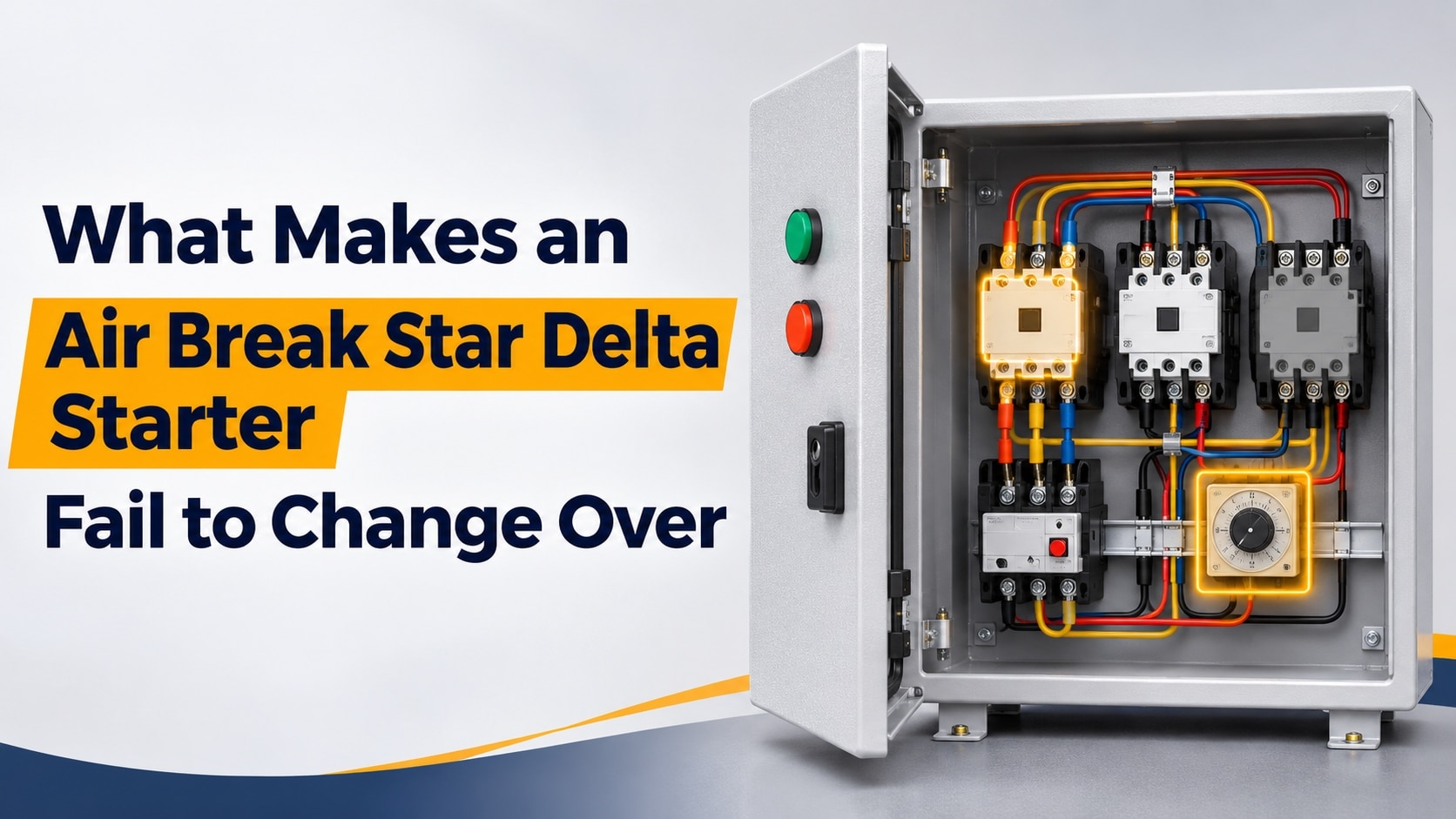
The correct sequence is main and star contactors closing together for starting, followed by the star contactor opening, an intentional open-transition interval, and then the delta contactor closing. If delta never closes, the motor is left in star and may not produce enough torque to accelerate the pump.
1. Confirm that the star and delta contactors have both mechanical and electrical interlocking. They must never close together; simultaneous closure can create a phase-to-phase short circuit.
2. Watch the contactor movement and measure voltage at the incoming terminals, motor terminals, and each control coil during the event. A failed timer output, wrong timer setting, loose control wire, burned auxiliary contact, failed interlock, or control fuse can release star before delta closes.
3. If incoming voltage remains present while a coil’s voltage disappears, inspect the stop circuit, overload auxiliary contact, phase-failure relay, emergency-stop circuit, timer output, and control supply. This pattern points to a control-side dropout, a common cause of star delta panel starting failure.
4. Set the timer from measured acceleration and current behaviour, not from a generic 15 hp value. Keep the motor in star long enough to approach operating speed, but not long enough to overheat; motor inertia, pump load, supply impedance, and transition design determine the setting.
A clamp-meter current trace can show whether the motor accelerates before the open transition and settles after delta closes. Do not bypass an interlock to force operation.
Where can a missing phase or voltage drop hide?
A normal incomer reading does not prove that the motor receives usable power. Submersible star delta power loss can develop across one high-resistance connection, so test under starting load at every point in the power path.
1. Record all three phase-to-phase voltages at the supply side and load side of the isolator while the motor starts. A phase that collapses only on the load side indicates a loose or burned isolator connection.
2. Test both sides of every fuse or MCB. A damaged fuse holder can show normal voltage without load, then create a severe drop when starting current flows.
3. Measure across each main, star, and delta contactor pole during acceleration. A burned pole produces an abnormal voltage drop even when the other poles appear healthy.
4. Check cable lugs, terminal screws, pump-cable joints, and the rising cable under load. An undersized feeder, damaged joint, or long cable can reduce voltage at the pump while the surface panel still appears normal.
5. Measure phase-to-phase voltage directly at the submersible motor terminals throughout acceleration and changeover. Record phase current on all three conductors with a clamp meter; compare voltage and current balance with the motor and supply documentation.
A three-phase motor does not need a neutral for its power circuit. A neutral fault matters when the panel uses neutral for its control circuit or accessories, where it can remove coil voltage without removing motor supply. Check the permitted voltage variation and phase-imbalance limits in the supply and motor documents.
How do you separate a motor or pump fault from a panel fault?
Separate them by proving the motor’s connection and condition before blaming the starter.
A fifteen hp pump panel fault is switching trouble when the motor and pump pass dead tests but the contactor sequence or coil supply fails; it is a load fault when correct voltage reaches the motor yet it draws abnormal current or cannot accelerate.
- Confirm six accessible winding leads and a nameplate connection suitable for delta at the supply voltage. A 400/690 V motor normally runs in delta on a 400 V system; a motor intended to run in star at that supply is unsuitable for this starter.
- Isolate and discharge the motor and cable, then test winding continuity and insulation resistance. Do not treat a megohmmeter result as proof of performance under load.
- Run live phase-balance and current tests during starting and changeover. Compare all readings with the nameplate and pump duty point.
- Check for a sand-locked or blocked impeller, excessive head, wrong impeller size, low bore-water level, damaged rising cable, seized pump, or motor insulation damage.
- For a centrifugal pump, a closed discharge valve usually reduces starting load. Never use that practice on a positive-displacement pump, where pressure and torque can rise dangerously.
| Evidence | Panel fault | Motor or pump fault |
|---|---|---|
| Coil voltage | Disappears before delta closes | Remains present |
| Motor terminals | Voltage collapses at a contactor or cable joint | Voltage holds while current stays abnormal |
| Dead tests | Motor and cable pass | Low insulation or unequal winding continuity |
| Acceleration | Switching sequence fails | Pump remains mechanically loaded |
Do not cure slow acceleration by increasing the overload setting.
When is the panel the part that needs repair?
Repair the panel when supply voltage stays within the documented range, the motor and pump pass their tests, but control-coil voltage disappears or the contactors fail to complete the star-to-delta sequence. That combination points to a starter fault rather than utility loss or a mechanically overloaded pump.
Ask the technician to check these items in order:
1. Record the trip indication, overload thermal state, phase-monitor event, timer sequence, and control-circuit voltage before resetting. Repeated resets can worsen burned or welded contactor contacts.
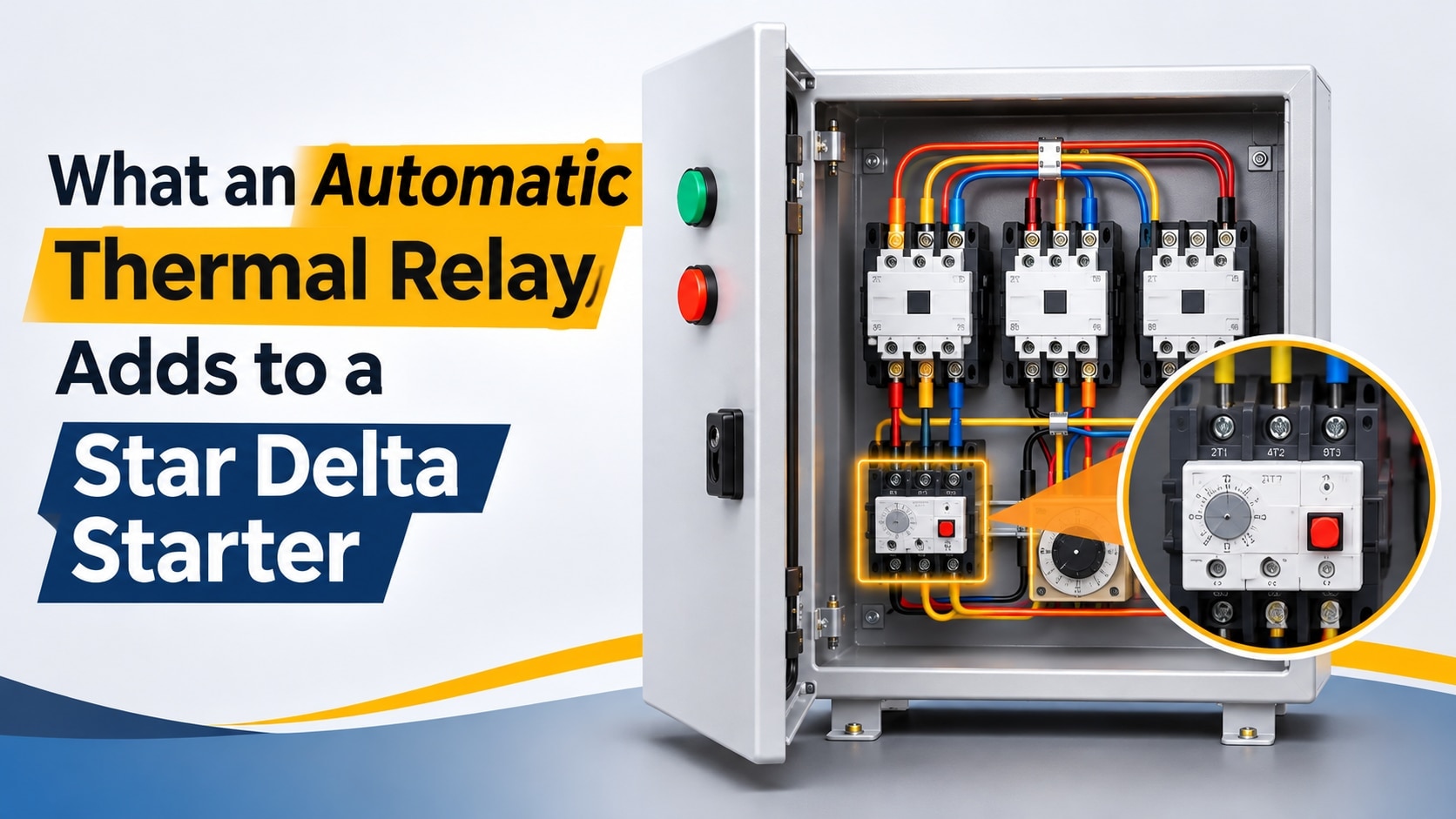
2. Verify timer output and setting, contactor coil rating, auxiliary contacts, mechanical and electrical interlocks, phase-monitor operation, emergency-stop and stop-circuit continuity, control fuse, and terminal tightness.
3. Capture the transition current trace. A star contactor that opens before the delta contactor closes leaves the motor without a valid running connection; a delta contactor that never closes leaves the motor in star and can prevent pump acceleration.
4. Confirm the overload setting against the relay’s sensing location and the starter manufacturer’s wiring convention. A relay in the line and one inside the delta loop read different current values, so do not apply a fixed multiplier to the nameplate current.
For a measured diagnosis in Coimbatore, MAG STARTERS (PRAVIN ENGINEERING) - 08048068970 is one local panel-support source. Give the provider the motor nameplate, cable length, voltage and current records, timer setting, and exact fault sequence—not only “the panel loses power.”
Related products
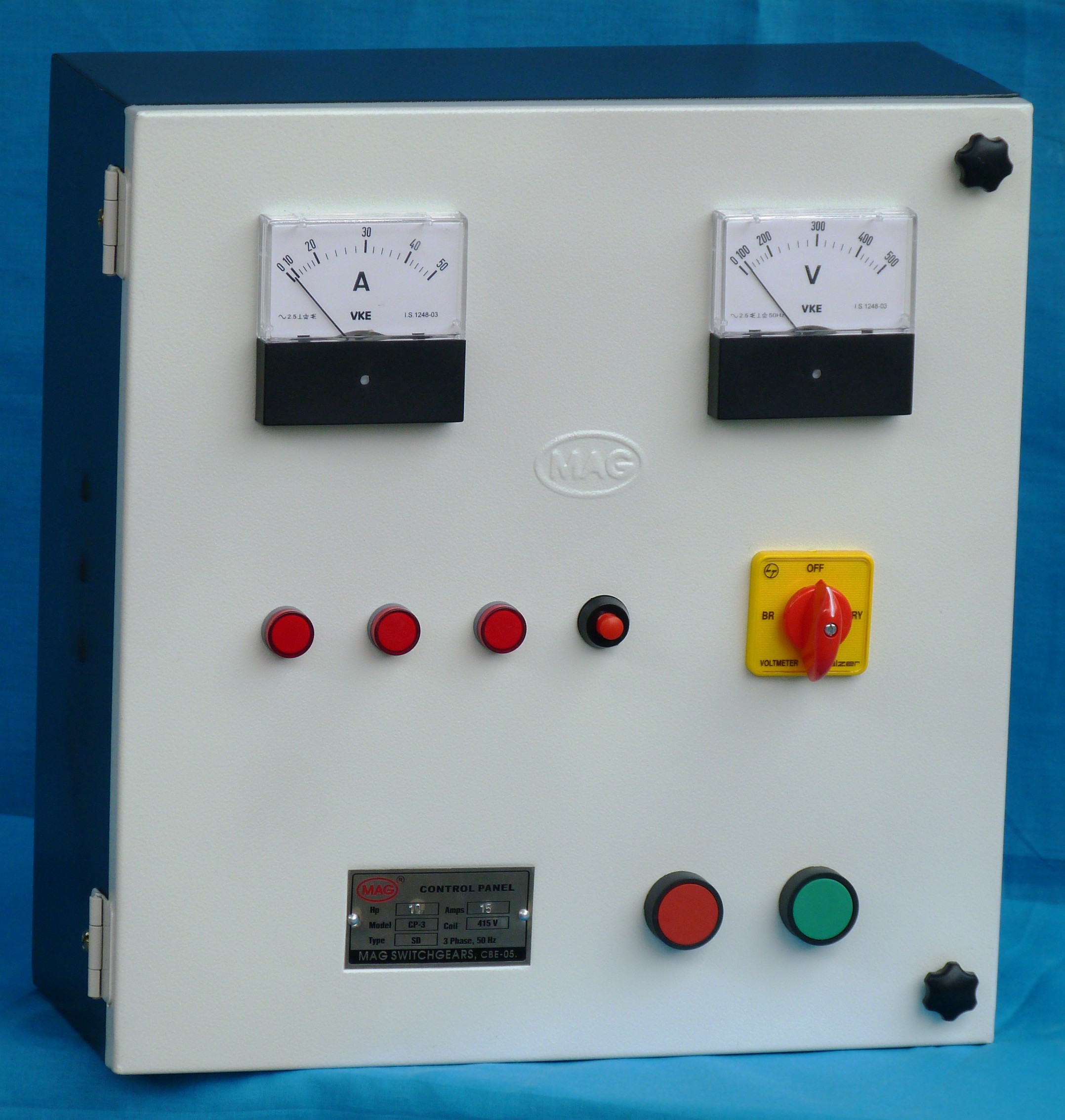 | Control Panel for Submersible Pumps Three Phase Panel - Star Delta 15HP ₹22010 • Ranging from 5 HP to 25 HP • Suitable for Bore-well Submersible Pumps • Analog Type Amps Meter & Volt Meter (Big-Square Type) • Bimetal Thermal... View product → |
MAGIC PUMP CONTROLLER PANEL 1+3 STAR DELTA PANEL MAGIC 15 HP ₹34270 1+3 STAR DELTA PANEL MAGIC UP TO 20 HP MAG Three Phase Panel Magic Model. View product → |
Frequently asked questions
What should you measure before resetting a fifteen HP star-delta panel?
Measure line-to-line voltage on all three phases, record the voltage during starting, and use a clamp meter to check each phase current. Inspect the overload relay trip indicator before resetting.
How should the star and delta contactors change over?
The star contactor closes first, the motor accelerates, star opens, and delta closes after the timer’s transition delay. Star and delta contactors must never remain closed together.
Where can a missing phase or voltage drop hide?
Check the incoming isolator, fuses, MCCB terminals, contactor poles, overload relay, cable lugs, timer connections and motor terminal box. Test voltage on both sides of each device while the motor starts.
How do you separate a motor or pump fault from a panel fault?
Compare phase currents, insulation resistance, winding resistance and shaft or pump movement. A balanced supply with abnormal current or insulation readings points toward the motor or pump.
When is the panel the part that needs repair?
Repair the panel when a contactor fails to pull in, a timer mis-sequences star-to-delta changeover, a protection device trips without a motor fault, or voltage is lost across a panel component.
Related product
 | Air Break Starters Air Break Star Delta Automatic Motor Starter 15HP ₹10550 We are one of the distinguished manufacturers and suppliers of Air Break Star Delta Automatic Motor Starter. View product → |
Keywords