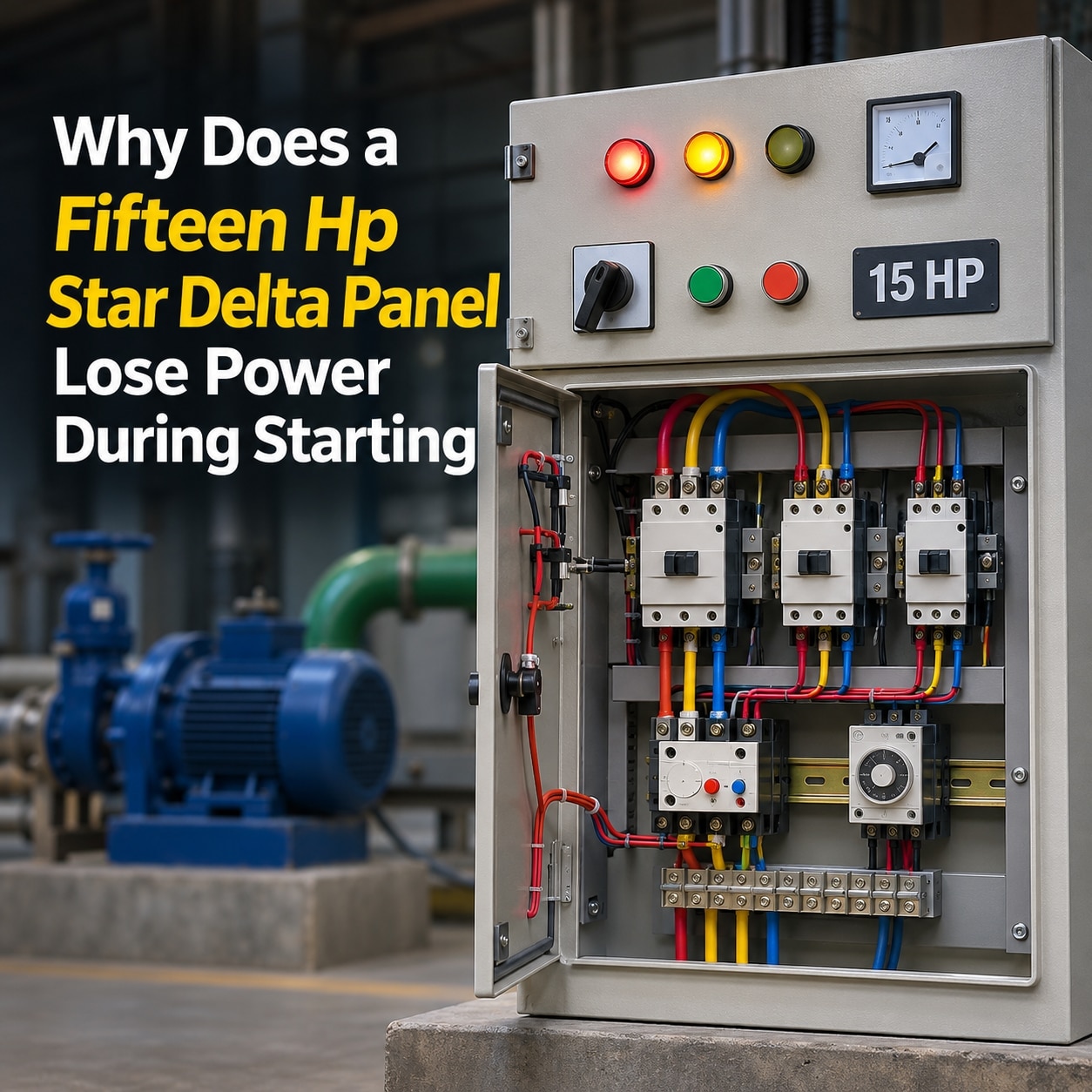
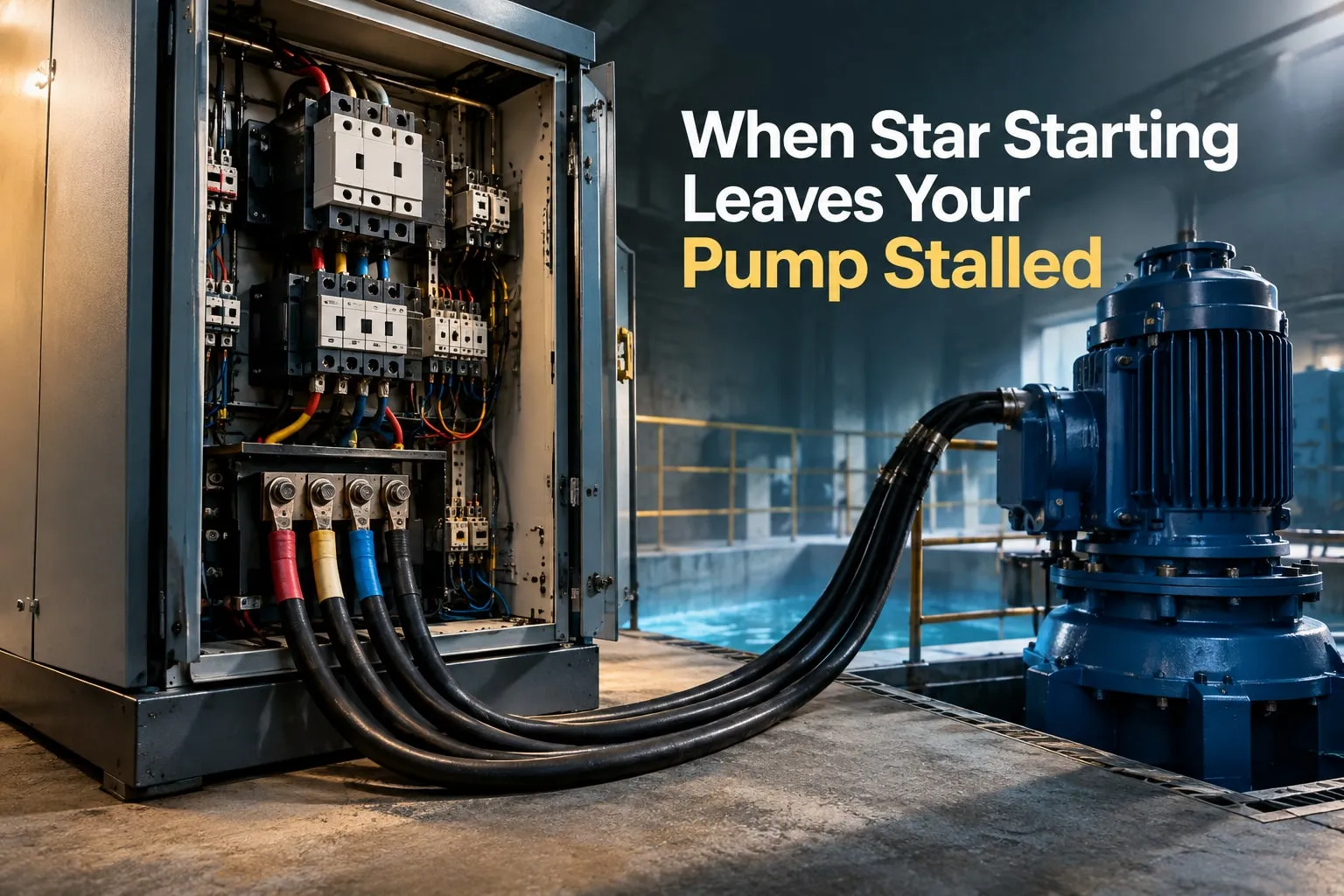
A large pump can have enough horsepower for continuous running yet fail during acceleration because star connection cuts available motor torque to about one-third of direct-on-line torque. By checking the pump’s hydraulic load, motor terminals, supply voltage, switching sequence, and protection settings, you can identify whether the fault is poor sizing, excessive voltage drop, incorrect wiring, or an unsuitable starting method.
Key takeaways
- Star connection cuts winding voltage to 58% and starting torque to about one-third.
- Measure acceleration time to separate star-phase failure from a faulty delta transfer.
- Match starter, motor, cable, contactor and protection ratings to the pump’s starting load.
- Choose a soft starter or VFD when star torque cannot accelerate the pump.
Why star starting leaves a large pump without enough torque
At star connection, each motor winding receives only line voltage divided by the square root of three—about 58% of its delta voltage. Because induction-motor torque follows voltage squared, available starting torque falls to roughly one-third of direct-on-line torque.
That is the electrical core of a large pump star delta starting problem: the motor may have adequate running power but still lack accelerating torque.
Acceleration requires motor torque to exceed pump-and-system torque at every speed, not merely at full speed. Compare the motor’s star torque-speed curve with the pump load curve, then allow for the rotating and liquid inertia of the complete assembly.
A voltage sag at the motor terminals reduces torque again because torque falls approximately with the square of voltage.
The hydraulic load can prevent acceleration when:
- Static head remains high during low-speed acceleration.
- An open or incorrectly controlled discharge path exposes substantial flow and pipe-friction torque; a closed valve often unloads a centrifugal pump, but does not remove mechanical inertia.
- A large impeller or high-viscosity liquid raises load torque.
- A long rising main adds resistance and stored liquid mass.
If the motor stalls below the speed needed for transfer, it remains in star with high current and inadequate torque. Increasing the star timer alone will not fix that condition; it only prolongs low-torque operation and can overheat the windings. A correctly selected motor and starter must reach transfer speed before the delta contactor closes.
How to tell a star-acceleration failure from a bad delta transfer
Use the event timing and simultaneous measurements: a motor that stalls before transfer has a star-acceleration failure; a motor that reaches speed but trips or surges during transfer has a changeover fault.
1. Record motor-terminal voltage, each phase current, phase imbalance, motor speed, and acceleration time while the star contactor remains closed. Speed that plateaus below the required transfer speed, with acceptable voltage, points to insufficient torque, excessive pump load, wrong motor connection, or excessive inertia.
2. Check the pump during this test. A nearly closed or incorrectly operating discharge arrangement, high static head, large impeller, long rising main, or viscous liquid can keep load torque above motor torque throughout star acceleration. Record pressure and valve position, not just electrical readings.
3. Observe the transfer sequence. If the motor reaches near-normal speed, then current spikes, torque shocks, pressure surges, contactor arcing, or an overload trip occurs as the star contactor opens and delta closes, suspect open-transition timing, residual-flux effects, incorrect phase sequence, contactor wiring, or inadequate interlocking.
4. Compare the voltage signature with the current. High current accompanied by depressed terminal voltage indicates supply impedance, transformer capacity, or cable voltage-drop trouble; acceptable voltage with stalled acceleration indicates a motor-pump torque problem. A timer adjustment alone will not repair a bad transfer.
Keep these records for industrial pump starter problems. They prevent an air-break starter from being blamed when the pump never accelerated, and prevent a genuine delta-transfer fault from being dismissed as an undersized motor.
How to verify motor, supply and air-break star-delta starter sizing
A 400 V motor marked 400 V delta / 690 V star is suitable for a 400 V star-delta arrangement; a motor marked 400 V star / 230 V delta is not. Confirm six accessible terminals, rated current, duty, starting frequency, acceleration time and locked-rotor current before judging star delta starter suitability.
For air break star delta starter sizing, obtain these details:
- Motor: voltage, delta-running connection, kW, full-load current, power factor, efficiency, service duty and permissible starts per hour.
- Supply: transformer kVA, secondary voltage, impedance, available short-circuit current and voltage measured at the motor terminals during starting.
- Cable: conductor material, cross-section, length, installation method, ambient temperature and calculated starting and running voltage drop.
- Protection: upstream fuse or circuit-breaker type and rating, overload-relay current range and setting, and documented Type 1 or Type 2 coordination.
- Contactors: AC-3 current rating, motor voltage, making and breaking capacity, short-circuit coordination, star and delta duty, mechanical interlock and timer changeover limits.
| Item | Verify | Why it matters |
|---|---|---|
| Motor | Delta voltage and six terminals | Incorrect connection can destroy the motor |
| Transformer | kVA, impedance and fault level | Low capacity causes starting-voltage collapse |
| Cable | Size, length and voltage drop | Excess drop reduces available torque |
| Protection | Fuse/breaker, overload and coordination | A contactor is not short-circuit protection |
| Contactors | AC-3 rating and fault withstand | Running-current rating alone does not prove safe switching |
Record phase currents, imbalance, acceleration time and transfer timing alongside these documents. A high starting current with depressed terminal voltage points to supply impedance; acceptable voltage with slow acceleration points to pump load, torque or timing.
Which commissioning checks expose the actual starting fault
Record the evidence while the pump is starting, not after the overload trips. These measurements separate supply limitation, excessive hydraulic load, motor wiring errors and transfer faults from genuine air-break starter problems.
- Measure voltage at the motor terminals before starting and throughout star acceleration. Record each phase-to-phase value and the lowest reading.
- Record each phase current in star and delta, then calculate phase imbalance. Capture motor speed, acceleration time and the exact star-to-delta transfer time.
- Photograph the motor terminal links and verify that the winding is intended to run in delta at the available supply voltage. Check every power and control termination for looseness, heat marks and contact wear.
- Record the overload relay setting, trip class, upstream fuse or circuit-breaker rating, and the motor nameplate current.
- Record discharge pressure, suction pressure, valve position and water level during the attempt. A closed valve, open valve, high static head or blocked line changes the starting load.
| Recorded result | What it points toward | What to inspect next |
|---|---|---|
| High current with depressed motor voltage | Transformer, cable or supply impedance | Cable size, length, joints and transformer capacity |
| Acceptable voltage but slow or absent acceleration | Insufficient torque or excessive pump load | Motor connection, impeller, head, valve and acceleration time |
| One phase current or voltage differs sharply | Phase loss, loose termination or imbalance | Fuses, terminals, contact tips and cable continuity |
| Motor accelerates in star but fails at transfer | Timer, interlock or contactor sequence fault | Star and delta contactor timing and auxiliary contacts |
These records prevent industrial pump starter problems from being assigned to the air-break starter without evidence.
When to choose another starter for a large pump
Reject the standard arrangement when the pump cannot reach transfer speed within the measured acceleration time, terminal voltage remains acceptable, and the load is still demanding more torque.
That is the practical answer to why air break star delta starter cannot start large pump in Coimbatore: the issue is not the city or horsepower, but insufficient star torque, hydraulic load, switching duty, or installation conditions.
| Option | Specify it when | Main requirement |
|---|---|---|
| Air-break star-delta | The pump unloads at low speed and accelerates reliably | Six motor terminals, delta-rated winding, AC-3 contactors, verified transfer timing |
| Soft starter | The pump needs a controlled ramp but no speed control | Select for motor current, ramp duration, bypass duty, and required starting torque |
| VFD | Static head, long rising mains, high inertia, or frequent starts demand controlled torque | Size for motor current, overload duty, acceleration time, enclosure cooling, and harmonics |
Specify a soft starter only after confirming that its available torque exceeds the pump’s starting torque. Choose a VFD when the pump needs low-speed torque, adjustable flow, reduced water hammer, or frequent cycling.
- State motor voltage, rated current, locked-rotor current, duty, starts per hour, acceleration time, and short-circuit current.
- Record enclosure IP rating, ventilation, condensation control, dust protection, clearances, and maintenance access.
- Ask MAG STARTERS (PRAVIN ENGINEERING) - 08048068970 to compare the panel against these measured conditions, not horsepower alone.
That evidence gives you a defensible star delta starter suitability decision.
Related products
 | Air Break Starters Air Break Star Delta Automatic Motor Starter 15HP ₹10550 We are one of the distinguished manufacturers and suppliers of Air Break Star Delta Automatic Motor Starter. |
 | Oil Immersed Starter CODE NO 033 Oil Immersed Starter Star Delta - Handle Type 10 HP ₹7710 • Ranging from 5 HP to 40 HP • Electrolytic Copper Contacts with Double Break System, Ensure long life and Better Conductivity • Changeover from Star... |
Frequently asked questions
Why does star starting leave a large pump without enough torque?
Each winding receives about 58% of delta voltage, and induction-motor torque falls to roughly one-third of direct-on-line torque. A high-inertia pump or high static head can therefore stall in star.
How can you distinguish star acceleration failure from bad delta transfer?
Watch motor speed and current during the star period. Failure to accelerate before transfer indicates insufficient star torque; a trip, surge or abrupt disturbance at transfer points to timer, contactor, wiring or phase-sequence problems.
What must you verify when sizing an air-break star-delta starter?
Check the motor nameplate voltage and connection, full-load current, locked-rotor current, pump inertia, starting head, acceleration time, cable size, contactor ratings and overload setting against the supply.
When should you choose another starter for a large pump?
Choose a soft starter or VFD when the pump cannot reach adequate speed in star, the supply cannot tolerate direct-on-line current, or controlled acceleration and pressure management are required.
Related products
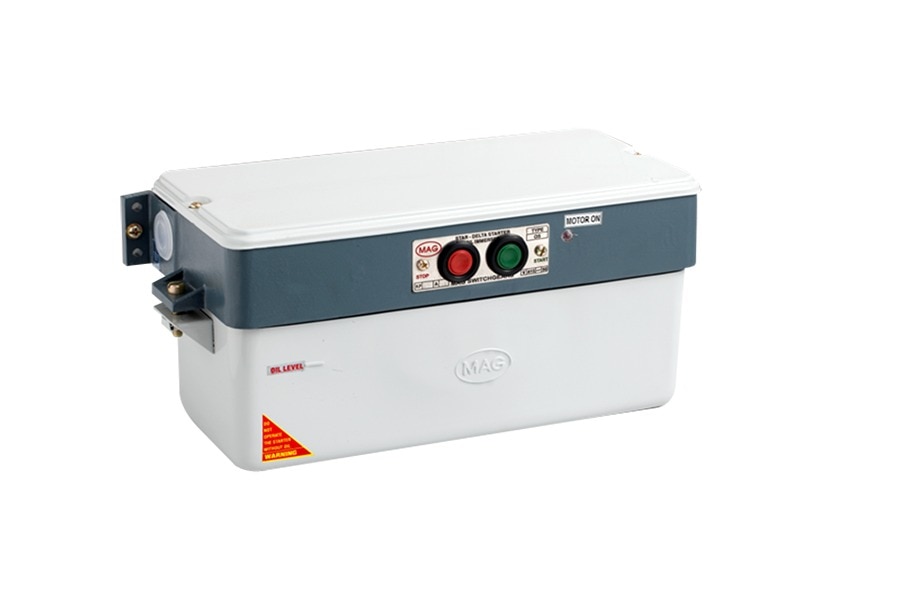 | OIL IMMERSED MOTOR STARTERS STAR DELTA - AUTOMATIC THERMAL RELAY 10HP ₹12890 • Ranging from 5 HP to 50 HP • Contacts made of Electrolytic Copper with Double Break System, Ensure long life and Better Conductivity • No Volt coil... |
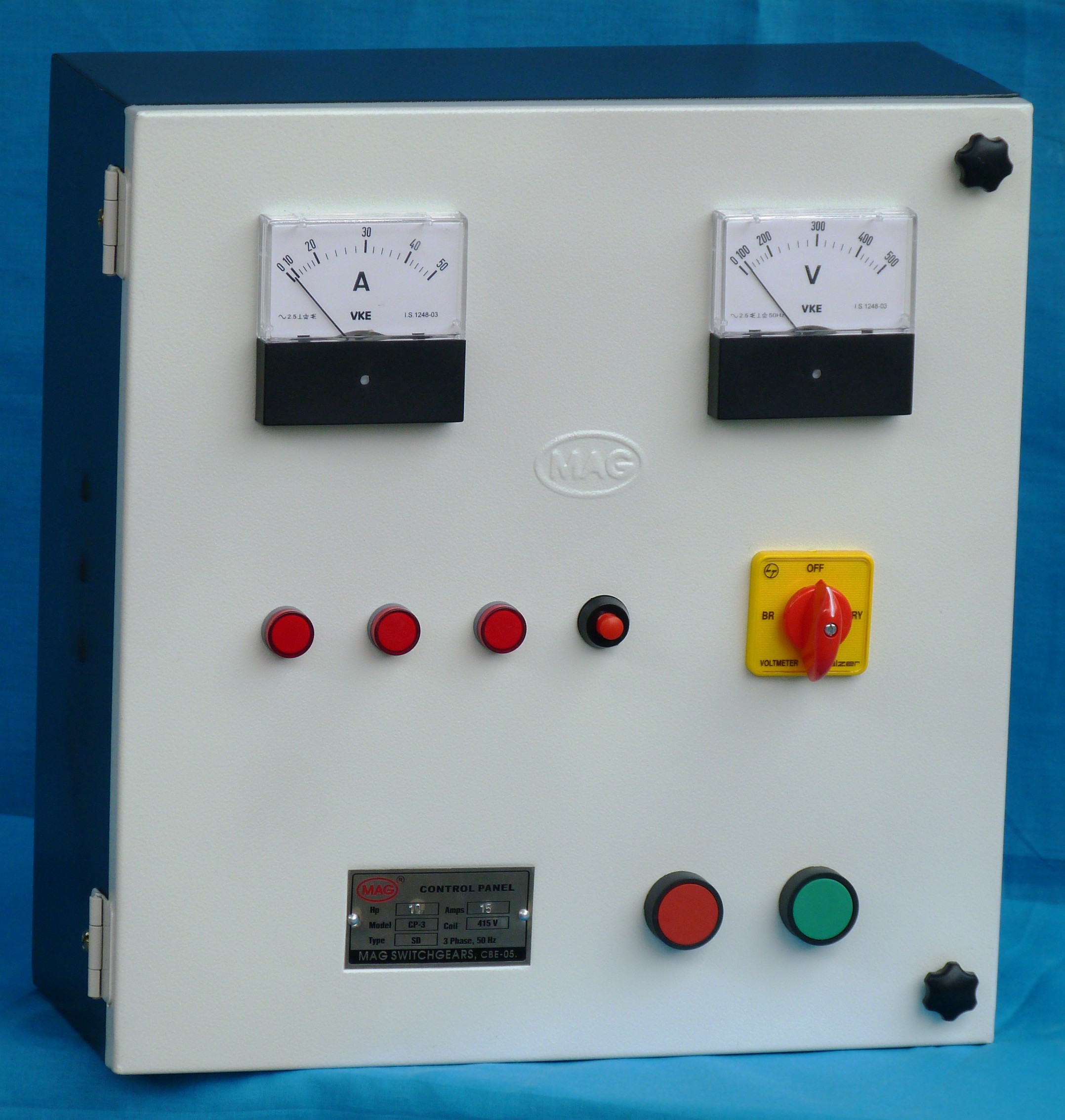 | Control Panel for Submersible Pumps Three Phase Panel - Star Delta 15HP ₹22010 • Ranging from 5 HP to 25 HP • Suitable for Bore-well Submersible Pumps • Analog Type Amps Meter & Volt Meter (Big-Square Type) • Bimetal Thermal... |
 | Submersible Control Panel Three Phase Star Delta Control Panel 20HP ₹24270 Features: Ranging from 5 HP to 25 HP Suitable for Bore-well Submersible Pumps Analog Type Amps Meter & Volt Meter (Big-Square Type) Bimetal Thermal... |
 | Oil Immersed Starter CODE NO 011 Oil Immersed Starter Heavy Duty Direct On-Line 10 HP ₹5540 • Ranging from 10 HP to 25 HP • Electrolytic Copper Contacts with Double Break System, Ensure long life and Better Conductivity • No Volt coil,... |
Keywords