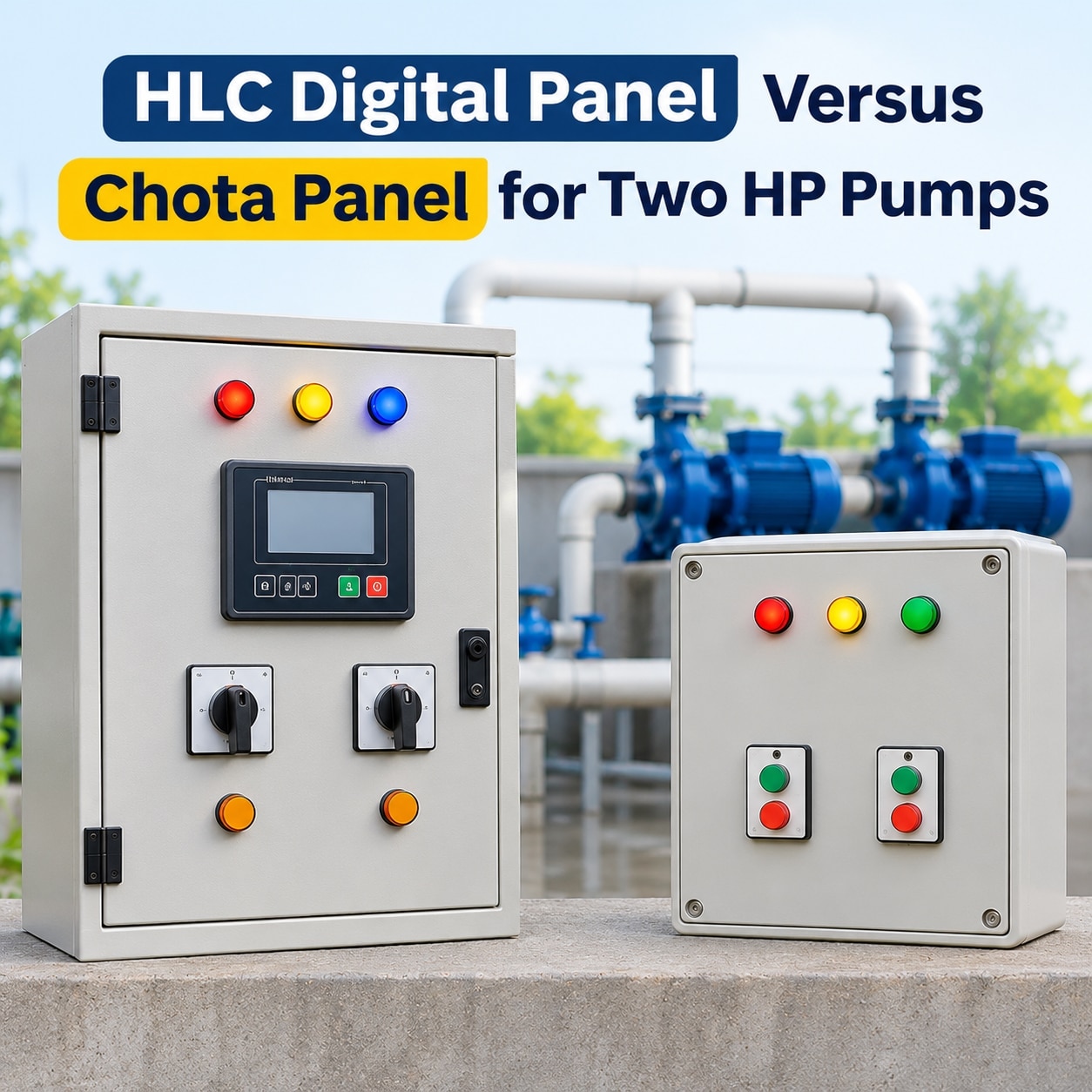
Choosing between an HLC digital panel and a Chota panel for two 2 HP pumps depends on the motor current, starting load, capacitor arrangement, control method and required automation—not on the product name alone. You will be able to match HLC digital control, Chota 1C, 2C or RT control to the installation, test the protection functions and compare a complete Coimbatore quote rather than two boxes with different specifications.
Key takeaways
- Match the panel to motor phase, supply voltage, starting current and switching arrangement.
- Confirm overload, dry-run and voltage protection settings at the actual pump installation.
- Compare display, automation, enclosure rating, service access and lifetime maintenance costs.
- Send motor and site details to a Coimbatore supplier before requesting an HLC or Chota quote.
The model name is not enough: match the panel to the job
Choose by the control job, not the model name: HLC digital control suits users who need a visible reading and combined functions, while Chota versions suit specific switching arrangements. HLC digital panel versus Chota panel for 2 HP pumps in Coimbatore is a model-to-model comparison, not a brand-versus-brand verdict.
| Option | What it means | When it applies |
|---|---|---|
| HLC digital | Display-based control with combined monitoring and automation functions | Manual or automatic pumping when you need visible readings, timer or float control |
| Chota 1C | One-contactor switching arrangement | One pump or one-contactor operation |
| Chota 2C | Two-contactor switching arrangement | Two pumps requiring separate contactor paths |
| Chota RT | Relay-type control arrangement | Relay logic where digital display functions are not the priority |
For manual pumping, choose the arrangement that gives a clear local start-stop function. Timer operation needs a timer input or built-in timer; float-switch automation needs compatible tank terminals and sensor wiring. Unattended domestic use requires defined responses to a full tank, low sump level, overload and dry-run trip.
Auto/manual operation is not two-pump alternation. Alternation equalises running hours, while duty/standby logic starts the second pump only when level or demand requires it. Confirm whether both pumps can run together, whether they start sequentially, and what happens after power returns, a dry-run or overload trip, or a tank-level change.
This is the practical test in an HLC panel versus Chota panel in Coimbatore.
Check the motor, supply and starting load before comparing prices
A 230 V single-phase 2 HP motor often draws about 10–12 A at 50 Hz; a 415 V three-phase motor is commonly around 3.5–4.5 A. Starting current can reach five to seven times running current, so two pumps starting together can cause voltage drop, nuisance tripping or failure to start.
- Record each motor nameplate current, 230 V single-phase or 415 V three-phase supply, 50 Hz frequency, starting current, capacitor-start or capacitor-run arrangement and specified capacitor value.
- Match the panel to an AC-3-rated contactor for motor duty, not a higher-looking resistive ampere figure. Check that each adjustable overload relay covers the nameplate current.
- Give the supplier the pump-cable length, borewell depth, delivery-pipe conditions and existing starter wiring. These affect voltage at the motor and starting performance.
- Require separate short-circuit protection, contactor and adjustable overload protection for each motor. Ask whether the controls start both pumps together or sequentially when the supply is weak.
A generic capacitor can cause poor torque, high winding current, overheating or early capacitor failure. Reject any quote for a three-phase motor, a motor above the controller rating, severe supply instability or an unsupported capacitor arrangement.
Use this checklist for a 2 hp digital pump panel comparison in Coimbatore or a single phase submersible panel in Coimbatore; the exact electrical schedule matters more than HLC or Chota branding.
Set and test overload, dry-run and voltage protection in the real installation
Protection works only when the installer commissions it against the actual motor and site. A 2 HP label is not a setting: use each motor’s nameplate current in amperes for the overload relay, and select the contactor for motor duty, normally AC-3, not its higher resistive-load ampere marking.
- Record the nameplate current, 230 V or 415 V supply, capacitor-start or capacitor-run arrangement, specified capacitor value, cable length and measured running current.
- Set overload protection from that nameplate current, then verify each pump separately. A wrong capacitor or long cable can increase current and cause heating.
- Identify dry-run detection. Current-based systems infer low load; probe-based systems depend on probe position and water conductivity. A low-load pump, incorrect threshold, long cable, misplaced probe or low-conductivity water can cause nuisance trips or missed trips.
- Test dry-run protection with a controlled low-water level, sensor simulation or measured current condition. Never deliberately operate the pump dry.
- Measure supply voltage at the panel while each pump starts and runs. The HLC 130–200 V low-voltage and 250–350 V high-voltage limits must suit the actual supply; outside those bands, confirm the trip delay and reset behaviour. A displayed voltage is not proof of protection accuracy.
- Confirm an upstream MCB or fuse for short-circuit protection, plus an RCCB or RCBO—commonly 30 mA for additional personnel protection—and a tested earth. An RCCB does not replace overload protection.
For a single-phase submersible panel in Coimbatore, record every trip during commissioning: overload, dry run, low voltage and high voltage. The panel passes only when measured current, trip timing and recovery match the motor and installation.
Compare automation, display, enclosure and lifetime service—not just the cabinet
A 2 HP digital pump panel comparison in Coimbatore is valid only when the quote covers the commissioned system, not just the cabinet. Check whether the display shows volts, amps, fault codes and run hours, or only status; confirm that timer, overhead-tank float, sump probes and dry-run protection work together.
| Option | Delivered capability | Trade-off |
|---|---|---|
| Manual starter | Contactor, overload and basic switching | Lowest complexity, but no automatic level control or voltage protection |
| External float controller | Float wiring added to a starter | More wiring and separate failure points |
| Separate voltage protector | Independent high/low-voltage trip | Added enclosure, terminals and service work |
| Digital panel | Integrated display, logic and protection | Higher initial complexity; verify every included function |
Request the exact terminal schedule, sensor type, sensor and pump cable lengths, capacitor, glands and accessories. For outdoor mounting, demand the IP rating, door-gasket detail, corrosion resistance, heat dissipation, sun and monsoon suitability, and service access without disturbing field wiring. A cable gland that leaks water can damage a sound controller.
- Confirm whether both pumps alternate, run together, or operate duty/standby; automatic restart after power failure or a protection trip must be stated.
- Define the domestic reset policy: manual reset after overload, dry-run or voltage trip is safer than an unexplained restart.
- Compare installation labour, programming, sensor wiring, replacement contactors, probes and displays, warranty terms and response time.
- Use the HLC panel versus Chota panel in Coimbatore as a model-and-service comparison, not a cabinet comparison.
Send this specification to a Coimbatore supplier before choosing HLC or Chota
Send this message to each supplier:
“Please quote for two 2 HP pumps. Attached are photographs and nameplates showing rated current, supply voltage and frequency. Capacitor value and type are: __. Borewell depth: ; pump-cable length: . Tank and sump arrangement: . Required operation: manual, timer, float or combination. Can both pumps run simultaneously?
Outdoor installation: yes/no. After power return or a protection trip, automatic restart must be: __.”
Ask for these documents and inclusions:
- Exact HLC or Chota model number, wiring diagram and terminal schedule.
- Enclosure material, stated IP rating, door sealing, glands and outdoor suitability.
- Contactor AC-3 rating, overload adjustment range, capacitor specification, included sensors and cable length.
- Commissioning scope, warranty, replacement-part availability and service response.
- A test record for overload, dry-run, float, timer and voltage trips.
| Option | Confirm in the quotation | Do not compare until |
|---|---|---|
| HLC digital | Exact model, display functions, sensor logic and restart policy | The wiring and protection test record are supplied |
| Chota 1C or RT | Contactor or relay arrangement, settings and service parts | The switching and fault-reset behaviour is documented |
| Chota 2C | Two-contactor wiring, simultaneous starting and interlock logic | Both-pump operation is demonstrated |
MAG STARTERS (PRAVIN ENGINEERING) - 08048068970 is a domestic pump panel supplier in Coimbatore you can ask for this model-specific documentation. For the HLC digital panel versus Chota panel for 2 HP pumps in Coimbatore, choose the option whose rated components, automation logic and service package match the nameplate and site.
Related products
 | SUBMERSIBLE CONTROL PANEL HLC SINGLE PHASE DIGITAL PANEL 2 HP ₹4980 HLC SINGLE PHASE DIGITAL PANEL AVAILABLE UP TO 3 HP Features Motor On - Manual Only Motor Off OPTIONS 1) Manual 2) Running Timer 3) Float Switch... View product → |
 | Control Panel for Submersible Pumps CHOTA Pump Controller Panel Single Phase - 2HP ₹8520 Available Models • Single Phase – 1C (Single Contactor) • Single Phase – 2C (Double Contactor) • Single Phase – RT (Relay Type) Features •... View product → |
Frequently asked questions
Is HLC better than Chota for two 2 HP pumps?
Neither model is automatically better. Choose after matching the panel to the motor phase, supply, starting load, switching arrangement and required protection functions.
What should you check before comparing HLC and Chota panel prices?
Check each motor’s phase and rated current, the available supply voltage, starting load, pump arrangement and whether the installation needs automatic alternation or separate control.
How should pump-panel protection be tested?
Set and test overload, dry-run and voltage protection at the real installation, using the connected pump, supply and sensors rather than relying only on factory settings.
What should you compare beyond the control-panel cabinet?
Compare automation functions, display information, enclosure construction, component access, installation requirements, service support and expected maintenance effort.
Keywords