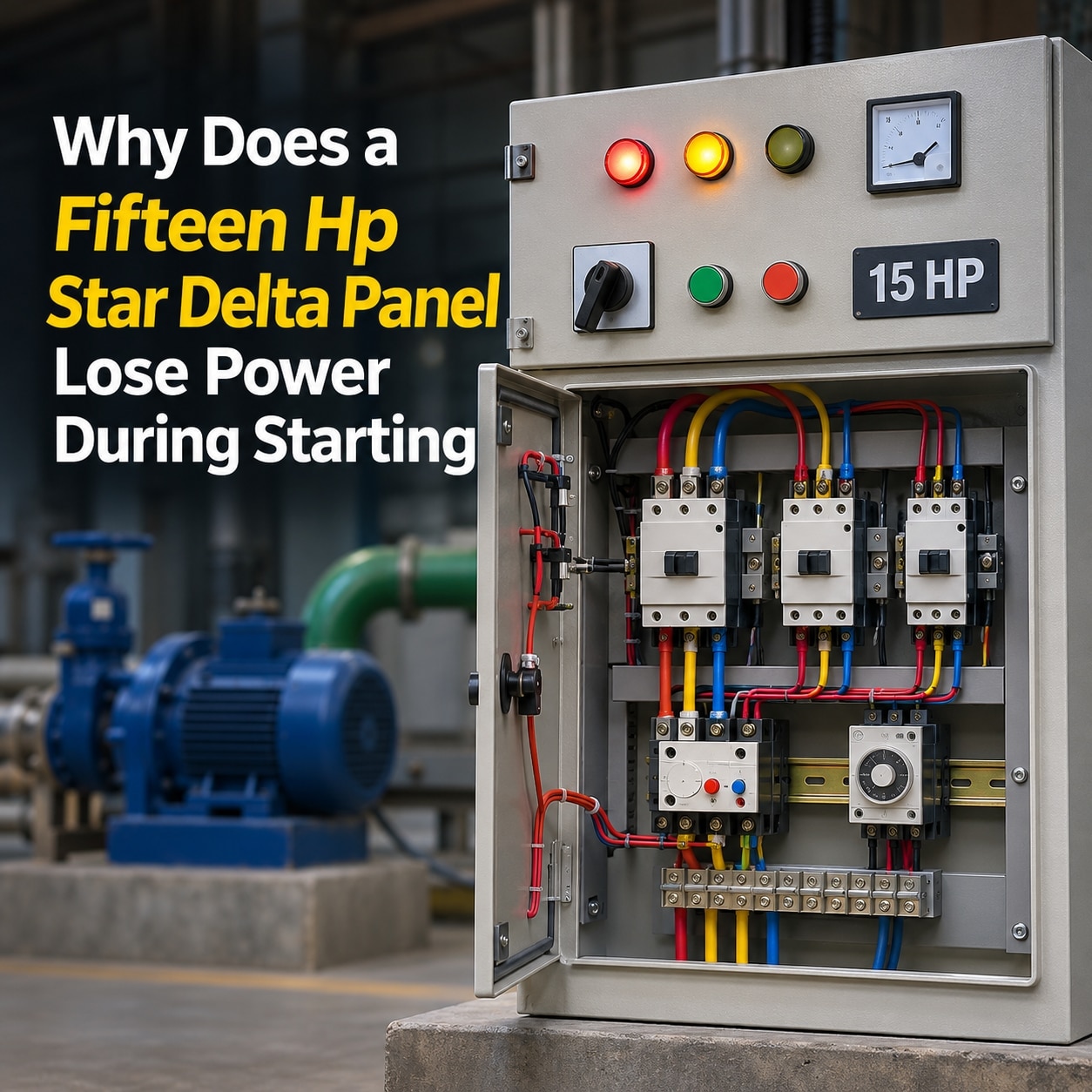
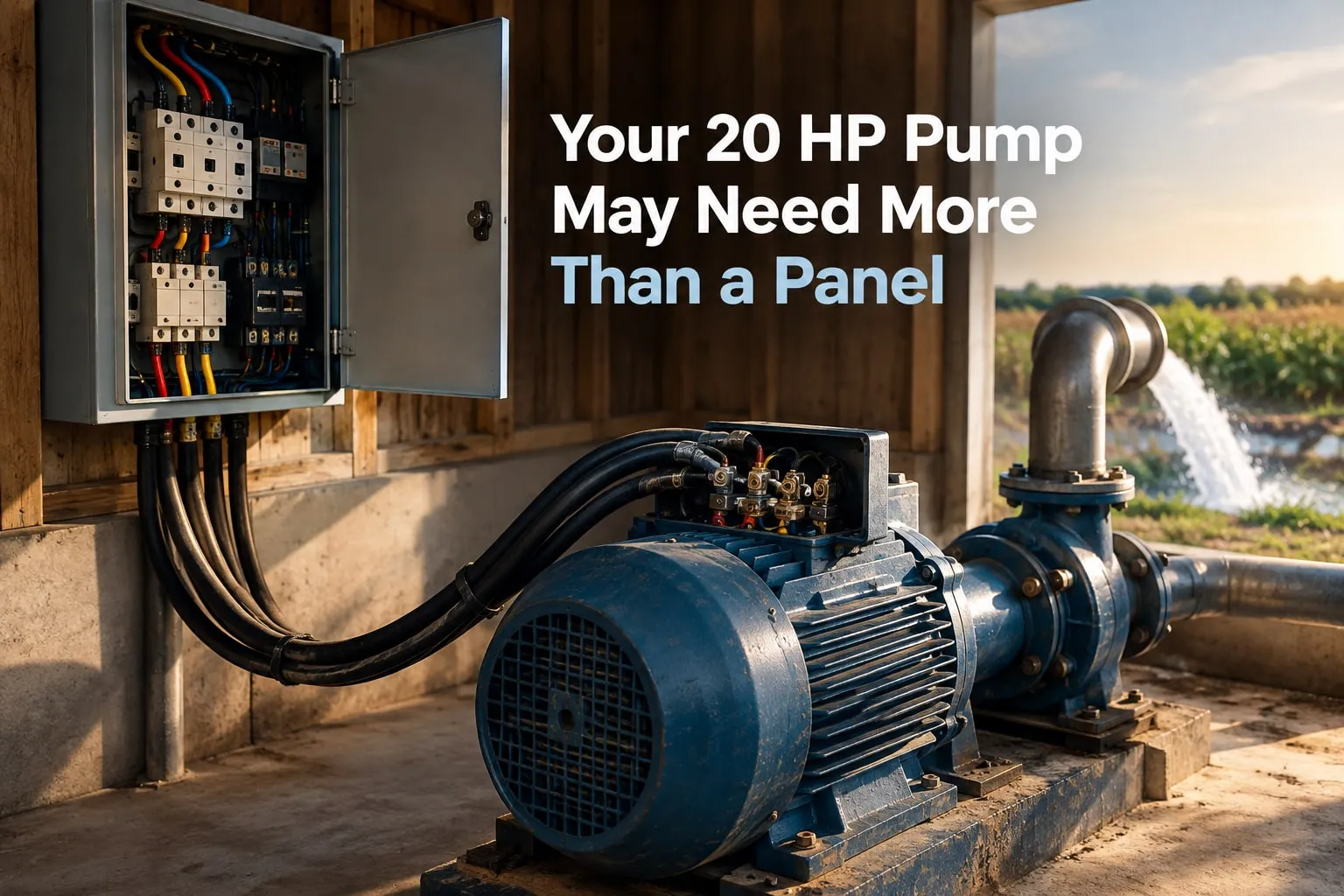
A 20 HP rating does not prove that a star-delta starter will work with your farm pump. By checking the motor nameplate, winding terminals, starting load, supply quality, protections, and panel specifications, you can decide whether this starting method is suitable before installation.
Key takeaways
- Match the panel to the motor nameplate, not horsepower alone.
- Confirm the motor supports star-delta starting through six accessible terminals.
- Check voltage, cable length, phase balance, and pump starting load.
- Specify separate protection for motor faults and dry-running pump conditions.
Start with the motor nameplate, not the 20 HP label
A 20 HP label identifies approximate mechanical output—about 14.9 kW—not compatibility. Read the motor nameplate and terminal box before choosing a 20 HP pump control panel. Confirm that the farm supply voltage and frequency match the motor, then use the nameplate full-load current for switching and protection decisions.
| Nameplate or motor detail | What to verify | Why it matters |
|---|---|---|
| Rated voltage and connection | Delta running voltage matches the supply | Incorrect delta voltage overheats the windings |
| Full-load current | Actual amperes, not a typical 20 HP estimate | Selects the overload range and cable size |
| Frequency | 50 Hz or the marked value | Changes speed and pump operating behaviour |
| Terminal access | Six separate motor terminals are available | Star-delta switching cannot work through three leads |
| Duty and pump load | Duty rating and starting requirements | High breakaway torque can prevent acceleration |
A suitable three-phase farm pump panel needs contactors rated for motor switching under AC-3, not merely a resistive ampere rating. Set the overload relay from the motor’s nameplate current, using the relay manufacturer’s instruction for the chosen line or delta arrangement; do not copy a generic 20 HP setting.
Star-delta is suitable only when the motor is designed for delta operation at the farm’s voltage and the pump accelerates fully before changeover. A centrifugal submersible pump often fits that condition, but a loaded discharge line, high water column, or pump requiring high starting torque can cause star-mode stalling, overload trips, or a harsh transition.
Understand what star-delta starting changes
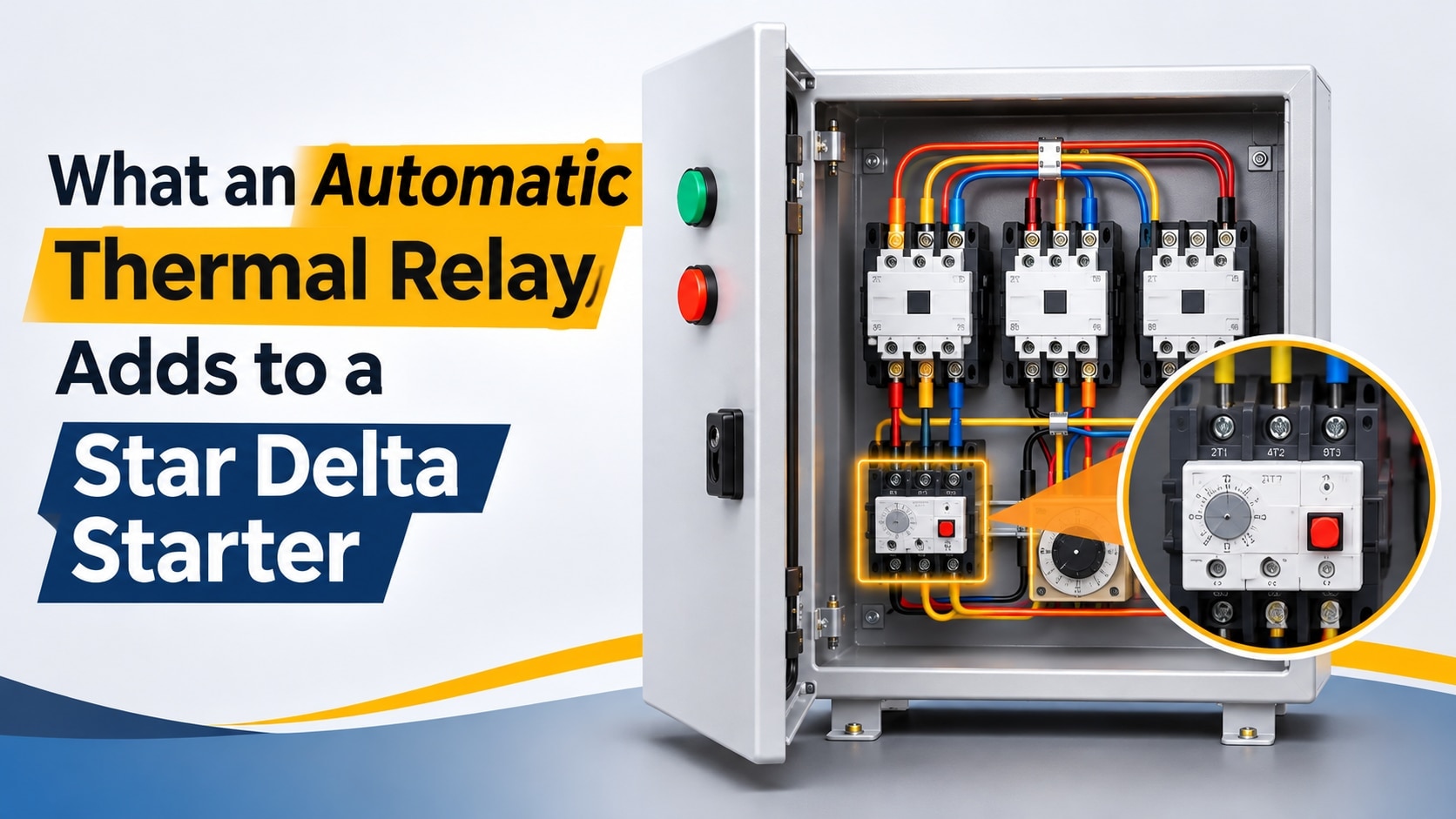
A star delta panel for irrigation starts the motor with its windings connected in star. This places a lower voltage across each winding, so the pump draws about one-third of the line starting current of direct-on-line starting.
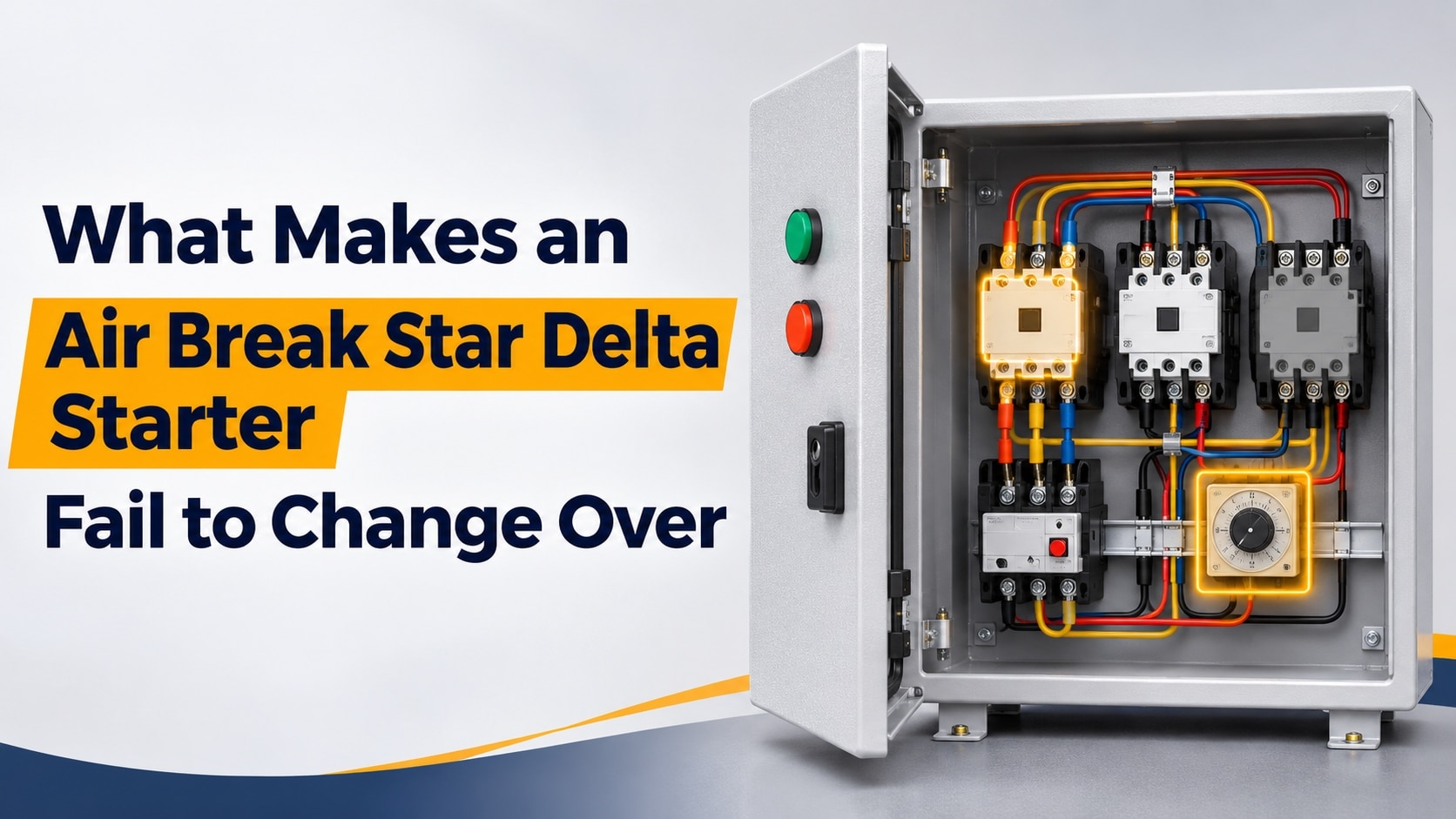
After the motor accelerates, the star contactor opens and the delta contactor closes, connecting the windings for normal operation.
The benefit has a cost: starting torque also falls to about one-third. That suits many centrifugal farm pumps, which need modest torque once water begins moving, but it can prevent a loaded pump from accelerating. The usual open-transition changeover briefly interrupts the motor supply and can create a current or torque shock during transfer.
A soft starter or closed-transition arrangement deserves consideration if the pump column, generator, or weak supply cannot tolerate that disturbance.
A three-phase farm pump panel sold as an agricultural pump starter panel is not automatically suitable for star-delta operation. Confirm that:
- The motor has six accessible terminal leads and is designed to run in delta at the farm supply voltage.
- The pump does not require high breakaway torque or start against a heavily loaded discharge line.
- The panel’s overload setting follows the motor nameplate current, wiring arrangement, and relay manufacturer’s instructions—not the 20 HP label alone.
Once the motor changes to delta, a conventional starter does not reduce its normal running energy consumption; it only limits the starting demand.
Check the farm supply, cable run, and pump load
A 20 HP label is not enough to approve a connection. Check the farm’s three-phase supply, the complete cable route, and the pump’s actual starting and running load before installing a three phase farm pump panel.
1. Measure the supply voltage between phases and confirm its frequency against the motor nameplate. Record voltage fluctuations during peak farm demand, and ask the utility or electrician for the available short-circuit level so the incoming protective device has an adequate interrupting rating.
2. Trace the cable from panel to motor, including the borewell section. Check conductor ampacity, total length, installation method, soil or ambient temperature, wet-location insulation, running voltage drop, and starting voltage drop. A long submersible cable can leave the motor under-voltage during star starting.
3. Identify the pump type and its starting condition. A centrifugal submersible pump usually has a different demand from a positive-displacement pump, and a loaded discharge line or high breakaway torque can make reduced-torque star starting fail.
4. Confirm that the motor’s full-load current matches the contactors’ AC-3 ratings, overload-relay range, and short-circuit protection. Set the relay from the nameplate current and the starter manufacturer’s line or delta wiring instructions, not from “20 HP” alone.
Also verify the enclosure’s outdoor rating, earthing, and protection against rain, dust, and insects. A star delta panel for irrigation is unsuitable if the supply is unstable, the cable drop is excessive, or the pump cannot accelerate before the changeover.
Separate motor protection from pump protection
A suitable control system must detect electrical faults separately from water-related failures. A 20 hp pump control panel that trips only on overload cannot prove that water is reaching the pump. Motor protection safeguards windings and cables; pump protection prevents operation under damaging hydraulic conditions.
| Protection type | Detects | Failure it prevents |
|---|---|---|
| Short-circuit protection | Fault current between phases or to earth | Cable, contactor and winding damage |
| Overload protection | Sustained current above the motor’s nameplate rating | Overheated windings from excessive load |
| Phase protection | Phase loss, incorrect sequence and severe voltage imbalance | Single-phasing, reverse rotation and overheating |
| Voltage and earth-leakage protection | Under-voltage, over-voltage and insulation leakage | Poor starting, shock risk and insulation failure |
| Pump protection | Low water, loss of prime, no-flow, blocked delivery or abnormal pressure | Dry running, loss of cooling and hydraulic damage |
Set the overload relay to the motor nameplate current, following the starter manufacturer’s instructions for the line or delta arrangement. Select the short-circuit device and contactors for the actual current and AC-3 motor duty, not the 20 HP label.
Dry-run protection is separate from overload protection. An agricultural pump starter panel can use a level probe, pressure switch, flow sensor, conductivity probe or undercurrent detection, but undercurrent can miss a dry-running pump that still draws substantial current. Choose the method for the borewell’s water-level behaviour and hydraulic system.
For outdoor installation, verify the declared IP rating under IEC 60529 and confirm that glands, door seals and condensation control preserve it after wiring.
Use a specification checklist before you buy
A 20 HP star-delta panel for farm pumps in Coimbatore is suitable only when its electrical ratings match your motor and site. The label “20 HP pump control panel” confirms neither six accessible motor terminals nor safe outdoor operation.
Use this checklist before ordering:
- Read the motor nameplate: confirm rated voltage, frequency, full-load current, delta running voltage, power factor, efficiency, duty, and permissible starting method.
- Open the terminal box: verify six separate winding terminals are available. A motor with three leads cannot use a standard star-delta starter.
- Confirm the farm supply: record three-phase voltage, 50 Hz frequency, voltage fluctuation, phase sequence, and the available short-circuit level.
- Match the protection: check the short-circuit device, contactors, and overload relay against the motor’s current and duty. Require an AC-3 contactor rating, not only a resistive ampere rating.
- Set the overload relay from the nameplate current and the panel’s line or delta wiring arrangement. Follow the relay manufacturer’s setting instructions, not the 20 HP label.
- Identify the pump and starting load: a centrifugal submersible pump often suits star-delta, but a loaded delivery line, water column, or high breakaway torque can prevent acceleration.
- Measure the cable length and size for voltage drop, then confirm the enclosure IP rating, cable glands, door seal, condensation control, dry-run protection, phase failure protection, and voltage protection.
MAG STARTERS (PRAVIN ENGINEERING) - 08048068970 can help you compare the proposed panel against these nameplate, site, and protection details rather than treating the horsepower label as the specification.
Related product
 | Submersible Control Panel Three Phase Star Delta Control Panel 20HP ₹24270 Features: Ranging from 5 HP to 25 HP Suitable for Bore-well Submersible Pumps Analog Type Amps Meter & Volt Meter (Big-Square Type) Bimetal Thermal... |
Frequently asked questions
Is a 20 HP star-delta panel suitable for every farm pump?
No. Check the motor nameplate, six-terminal connection, supply voltage, frequency, full-load current, and pump starting load before selecting the panel.
What does star-delta starting change?
It reduces starting current by starting the motor in star and then changing to delta, but it also reduces starting torque during the star period.
What should you check in a farm electrical supply?
Verify the three-phase voltage and frequency, cable size and run length, phase balance, voltage drop, earthing, and available starting capacity.
Does motor protection also protect the pump?
No. Overload and phase-failure protection protect the motor, while dry-run, low-water, level, flow, and related controls address pump operating conditions.
What specifications should you request for a 20 HP pump control panel?
Request the rated voltage and frequency, motor full-load current range, contactor ratings, overload range, transition timer, enclosure details, protection functions, and wiring diagram.
Keywords