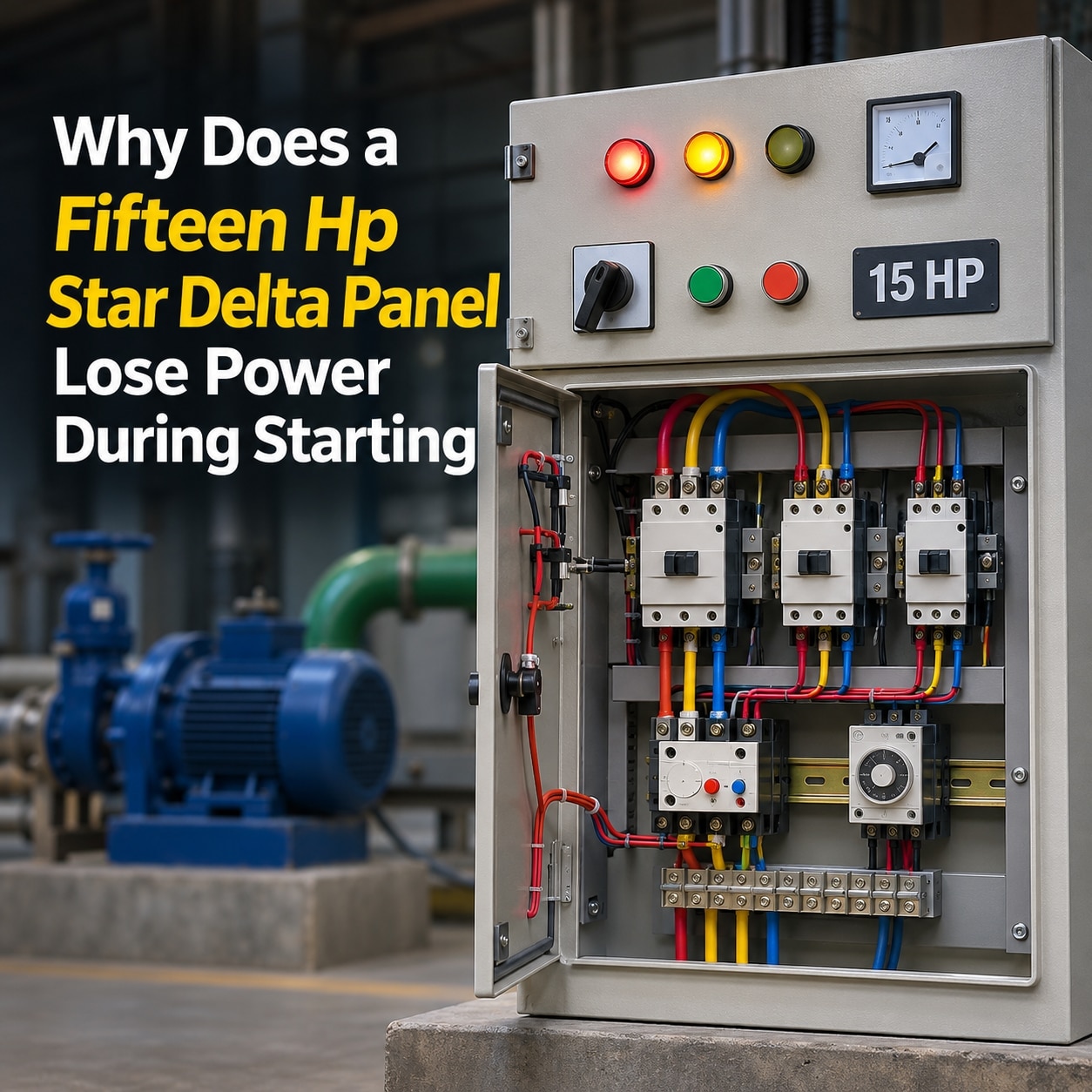
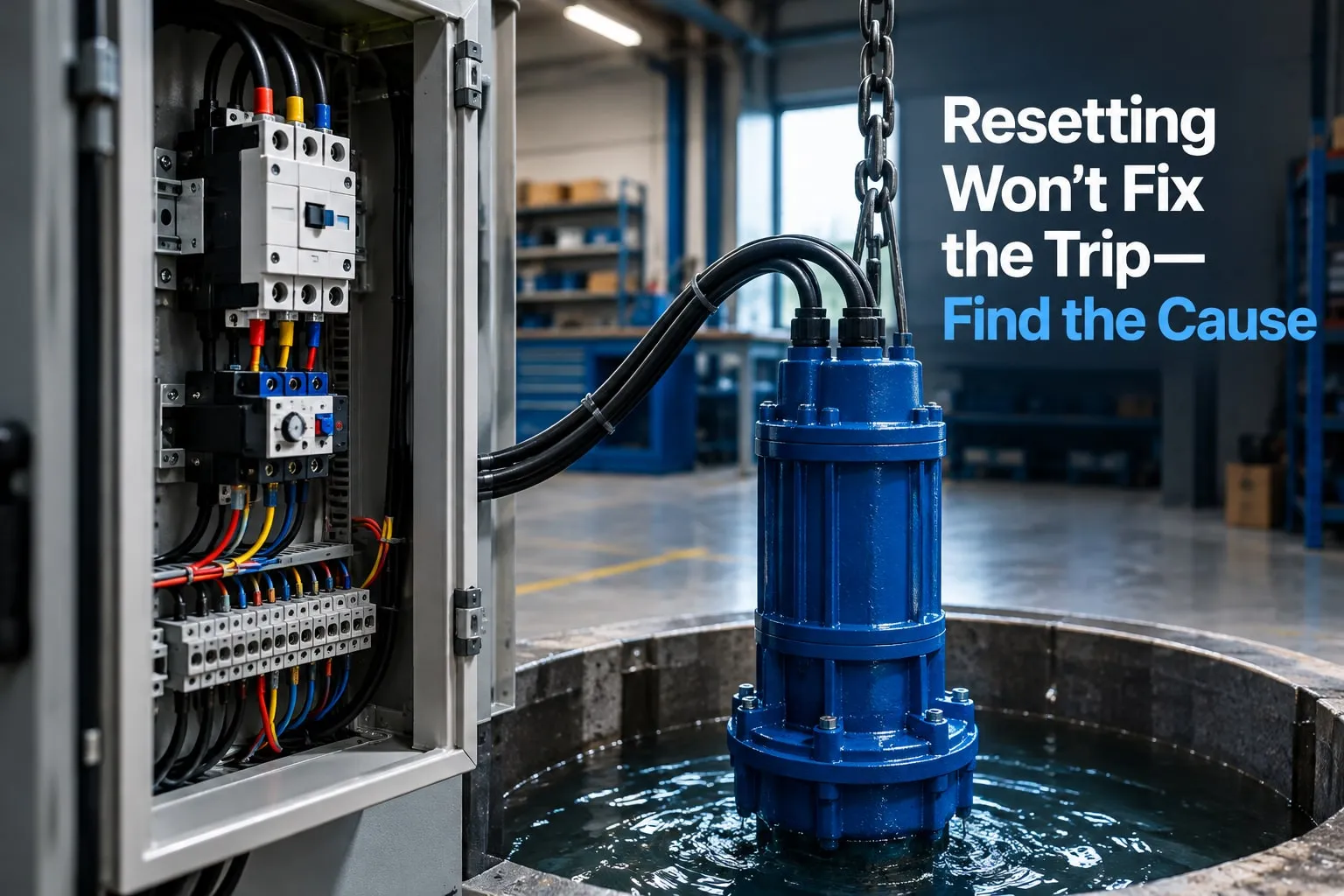
First identify which protective device operated and when the pump stopped: an overload relay, short-circuit breaker, earth-leakage device, contactor control circuit, or incoming supply failure. Then use loaded voltage, current, insulation, terminal, and pump-condition checks to locate the cause instead of repeatedly resetting the starter.
Key takeaways
- Identify whether the overload, short-circuit, or earth-leakage device tripped.
- Compare all phase currents and loaded voltages before changing the overload setting.
- Inspect terminals, cables, motor windings, pump bearings, and impeller for overload causes.
- Record trip timing and start frequency before specifying a repair or replacement.
Identify the Trip Before You Reset the Pump
A three phase pump starter trip fault begins with identifying the device that operated, not with pressing Reset. In an air-break DOL starter, an overload relay normally opens the contactor control circuit; a short-circuit device or earth-leakage device acts for a different fault.
| Device or event | What it means | Timing clue |
|---|---|---|
| Overload relay | Motor overload, phase loss, or relay function operated | Often after heating |
| MCB, MCCB, or fuse | Short circuit or very high fault current interrupted supply | Usually immediate |
| Earth-leakage device | Leakage to earth or insulation fault detected | Immediate or intermittent |
| Contactor drop-out | Control voltage disappeared, interlock opened, or coil failed | May occur without a protective trip |
| Supply-side power failure | Utility, upstream breaker, or phase supply was lost | All control indications may go dead |
Before any reset, record:
- Overload-relay indicator and breaker position
- Earth-leakage indication and control-circuit status
- Whether the contactor releases without an overload, breaker, fuse, or earth-leakage device showing a trip
A trip during starting points toward locked rotor, excessive DOL inrush, short circuit, severe voltage loss, phase loss, or a jammed pump. A trip after several minutes points toward accumulated heat from overload, voltage imbalance, restricted cooling, frequent starts, or a partly blocked pump.
Isolate the supply before opening the panel. Do not increase the overload setting or repeatedly reset the starter; repeated resetting can damage the motor and contactor. This timing record often separates an air break dol starter repeated tripping problem from a control or supply failure.
Check the Overload Setting, Current, and Loaded Voltage
Prove an air break starter overload problem with measurements, not repeated resets. Copy the motor nameplate voltage, full-load current, phase arrangement, and duty information. Set the overload relay to the nameplate full-load current, following the starter and motor manufacturer’s instructions. A higher setting defeats protection; a setting well below the permissible current causes nuisance trips.
- With safe access, use a clamp meter to record all three running currents.
- Measure all three line-to-line voltages at the starter while running, then repeat at the motor terminals. Measure during starting when voltage collapse is suspected.
- Calculate each imbalance as: percentage imbalance = maximum deviation from the three-phase average ÷ average × 100. Apply this separately to current and voltage, then compare both results with the motor manufacturer’s limits.
- Stop testing if you find a missing phase, an overheating terminal, or severe imbalance. Do not increase the relay setting.
| Comparison | Calculation or check | Meaning |
|---|---|---|
| Current | Three phase readings and current imbalance formula | High current proves overload; unequal current points to phase or connection trouble |
| Voltage | Starter and motor line-to-line readings and voltage imbalance formula | Low, unequal, or collapsing voltage can drive current upward |
| Setting | Relay setting versus nameplate full-load current | Above rating removes protection; far below rating causes nuisance trips |
After isolating the motor, disconnect electronic equipment and use an insulation tester. Select the test voltage and acceptance criteria specified by the motor, cable, and installation standard; never substitute an arbitrary field value.
Trace Phase Loss, Bad Connections, and Mechanical Overload
A three phase pump starter trip fault can be genuine even with a healthy incoming supply. Organise the inspection into three fault groups; an air break starter overload problem is not repaired by repeatedly increasing the relay setting.
| Fault group | Inspect | What it proves |
|---|---|---|
| Phase loss or imbalance | Loose terminals, burnt contactor tips, welded or failed contact poles, damaged cable cores, corroded submersible-pump joints, damaged overload-relay elements, undersized cables, and water inside the panel | A missing phase can leave the motor running on two phases. Voltage drop or a high-resistance connection creates heat and imbalance; increasing the relay setting does not repair it. |
| Pump and motor overload | Seized or tight bearings, blocked impeller, damaged coupling, sand or debris fouling a submersible pump, excessive discharge head, and operation away from the pump curve’s duty point | Compare each measured running current with the motor nameplate current and the pump-curve duty. Healthy supply voltage does not prove a healthy pump. |
| Dry running | Source level, suction conditions, delivery flow, and the control intended to stop the pump | Loss of water can damage the pump and alter its load, so verify the dry-run protection rather than assuming an electrical fault. |
Isolate the supply before opening the panel. Repair the open or high-resistance connection, mechanical restriction, or failed dry-run control identified by testing; do not keep resetting the starter.
Decide Whether Starting Current or Repeated Starts Are the Cause
A trip during acceleration usually points to excessive DOL starting current or insufficient voltage at the motor. Direct-on-line starting applies full line voltage and draws high inrush current; a high pump starting load, weak utility supply, long cable run, or substantial voltage drop can prevent the motor reaching speed.
Compare starting voltage at the motor terminals with running voltage and record acceleration time. Check cable length, conductor size, supply capacity, and utility voltage under load. A voltage reading at the incoming isolator alone can miss the fault.
For an air break dol starter repeated tripping complaint, inspect the control sequence:
- Rapid pressure-switch cycling or float-switch chatter
- A leaking non-return valve that lets pressure fall and restarts the pump
- A start schedule that gives the motor and thermal overload relay too little cooling time
These conditions create an air break starter overload problem even when steady running current looks normal. The thermal relay’s trip class and reset behaviour must suit the motor’s acceleration time and the manufacturer’s coordination tables. Choosing a slower class only to conceal mechanical or electrical overload is unsafe.
| Option | Decision | When it applies |
|---|---|---|
| DOL | Retain it | Motor reaches speed within design time and supply voltage holds |
| Star-delta or reduced-current starter | Assess before selecting | Starting load, cable distance, or voltage weakness prevents reliable acceleration |
Obtain a motor, pump, cable, and supply assessment before changing the starting method. Verify the replacement starter’s motor rating, not horsepower alone.
Specify the Repair With Evidence, Not a Replacement Guess
Approve a repair only after the technician identifies the device that operated and records evidence. A contactor replacement alone does not establish the cause; repeated resetting can damage both the motor and contactor.
1. Require a service report listing the motor nameplate current and voltage, three measured running currents, all three loaded line-to-line voltages, overload setting and trip class, trip timing, cable length and size, pump model or duty point, and insulation-test result.
It must identify whether the overload, MCB or MCCB, fuse, earth-leakage device, or control circuit operated.
2. Require control-circuit checks for low control voltage, a loose neutral where used, a failing seal-in auxiliary contact, defective float or pressure switch, undervoltage-release action, and a loose overload auxiliary contact. A contactor that drops out with normal motor current needs control-circuit testing, not an automatic overload replacement.
3. Ask for the motor to be isolated before insulation testing, with test voltage and acceptance criteria taken from the motor, cable, and installation standard. Stop approving parts if measurements are missing or the fault indication is unclear.
4. For air break dol starter keeps tripping three phase pump in coimbatore or dol starter repair in coimbatore, local service is worthwhile when the technician will document these tests. MAG STARTERS (PRAVIN ENGINEERING) - 08048068970 can be considered for that conversation; provide the measurements before approving parts or replacement.
Repair the failed connection, supply, pump, control circuit, or protection setting identified by testing, not the symptom shown by the last trip.
Related products
 | Air Break Starters Air Break DOL Three Phase Motor Starter 10HP ₹2920 We are engaged in offering our clients with a qualitative range of Air Break DOL Three Phase Motor Starter. |
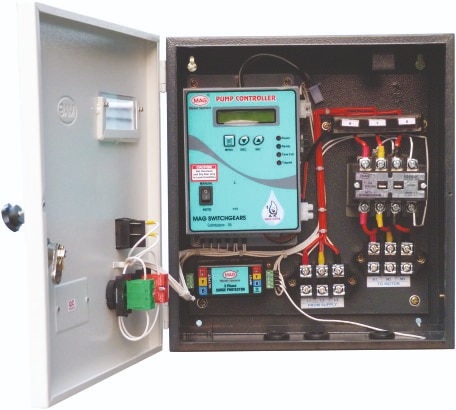 | MAGIC PUMP CONTROLLER PANEL Pump Controller Panel Three Phase - DOL 10 HP ₹10000 Available Models • Three Phase – DOL • Three Phase – Star Delta Features • Automatically runs the pump • Auto load settings for Overload and Dry Run... |
Frequently asked questions
Why should you identify the trip device before resetting a three-phase pump?
An overload relay, short-circuit device, and earth-leakage device indicate different fault types. Resetting without identifying the device can hide a dangerous electrical or mechanical problem.
How do you check whether the overload setting is correct?
Read the motor nameplate full-load current, compare it with the relay setting, and measure each phase current while the pump is loaded. Do not increase the setting to stop nuisance trips.
What causes phase loss or unequal current in an air-break DOL starter?
Loose terminals, burnt contactor contacts, damaged cables, blown fuses, and motor winding faults can remove or weaken one phase. Inspect connections and compare phase-to-phase voltage under load.
How can starting current and repeated starts trip a pump starter?
A DOL motor draws high inrush current at startup. A jammed pump, low supply voltage, long acceleration time, or frequent starts increases heating and can trip the overload relay.
What evidence should you provide for a DOL starter repair?
Provide the trip device, trip timing, motor nameplate current, three phase currents, loaded voltages, start count, terminal condition, and pump or motor inspection findings.
Keywords