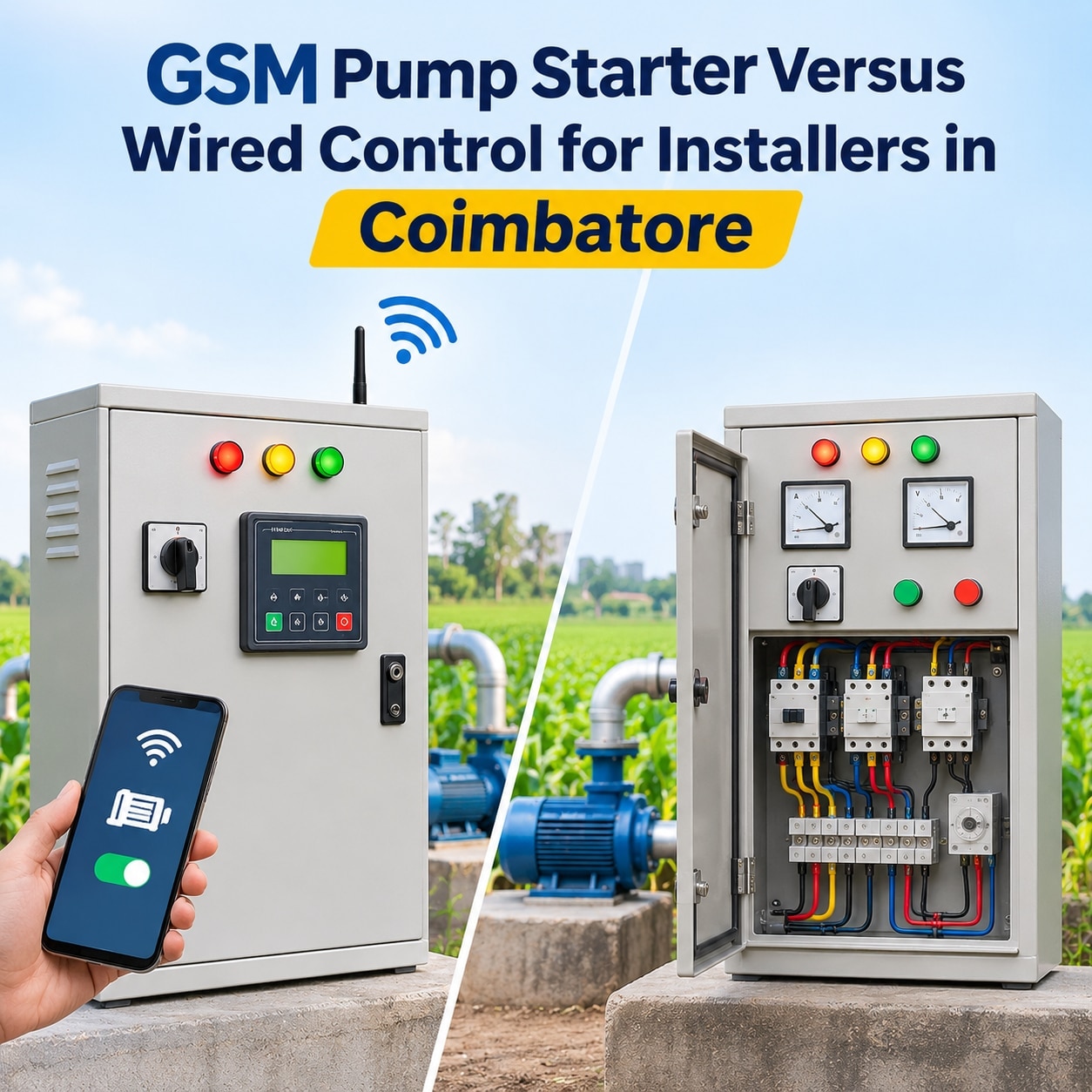
A GSM starter changes the command path, but it does not replace the contactor, overload protection, isolator, or safety interlocks that make a pump installation safe. By comparing the site conditions, wiring effort, network risks, protection architecture, and recurring responsibilities, you can recommend the control method that fits the installation rather than the one that sounds more convenient.
Key takeaways
- Keep overload, short-circuit, isolation, and interlock protection local.
- Choose GSM only where mobile signal and remote access justify added complexity.
- Use wired control for reliable local operation with simpler fault finding.
- Price cabling, enclosure work, commissioning, and GSM service separately.
What actually differs between GSM and wired pump control?
The difference is where each signal travels: GSM control uses a mobile network for commands, while wired control uses local switches, relays, and control cables. In both systems, the motor’s protection path remains electrical and local; a phone command must never bypass the contactor, overload relay, short-circuit protection, isolator, or safety interlocks.
| Option | Command path | Protection path | Status path |
|---|---|---|---|
| GSM unit | SMS, app, or call reaches an onboard relay, which operates the contactor coil | Hard-wired overload, breaker, isolator, phase protection, and interlocks | Dedicated inputs report tank level, dry-run, trip, or power failure through SMS, app, or alarm output |
| Wired control | Push button, selector switch, float switch, or remote relay travels through control wiring | Same motor protection, with cable protection, segregation, and voltage-drop control | Auxiliary contacts, lamps, meters, or local panel indicators show the condition |
A GSM relay is not a horsepower-rated motor starter. It is a communication device that changes a command contact; the complete starter architecture still determines safety.
For pump control options in Coimbatore, test cellular coverage at the installed panel, not beside the road or in a nearby building.
A weak signal, expired SIM, panel power loss, or failed message breaks the GSM command path, whereas a wired circuit gives a deterministic local command but exposes its cable to damage, induced voltage, and voltage drop.
The practical GSM unit versus wired pump control choice therefore depends on whether saving travel outweighs added communication, antenna, service, and fault-finding points. A GSM system also needs confirmed feedback; without it, “start” only means that a command was sent.
Which control method fits the pump site?
Choose a GSM mobile unit when the pump panel is far from the operator, travel to the borewell or farm is costly, and a reliable mobile signal is available at the exact installation point. Choose local wired control when the operator stays near the panel, the cable run is short, or network service is uncertain.
| Factor | Choose GSM mobile unit | Choose local wired control |
|---|---|---|
| Operator access | Remote borewell, farm, or isolated tank | Control room or panel within easy reach |
| Command path | SIM, mobile network, phone command, onboard relay | Push buttons, selector switch, relays, and control cable |
| Automation | Remote sump or overhead-tank operation with feedback | Float switches and local automatic circuits |
| Failure exposure | Signal loss, inactive SIM, power loss, or failed command | Cable fault, switch failure, or relay fault |
| Best value | Saves repeated travel after commissioning | Simpler installation and fault finding |
For a remote pump starter comparison in Coimbatore, test coverage at the exact borewell location; urban, industrial, and outlying agricultural sites can differ sharply. GSM does not replace the contactor, isolator, short-circuit protection, overload relay, or hard-wired safety interlocks, and it must include local manual bypass with a defined state after power or communication recovery.
Price the GSM unit, enclosure, antenna surge protection, SIM service, sensors, commissioning, and future troubleshooting separately. Commission cold start, weak-signal operation, command timeout, power restoration, and status confirmation before handover. This is the practical GSM pump starter versus wired control in Coimbatore decision.
What installation work does each option require?
A wired installation usually takes more cable work but leaves fewer hidden dependencies. A GSM unit can shorten the control run to a remote borewell, yet it adds a SIM, antenna, auxiliary supply, signal test, and communications fault path.
| Option | Wiring and sensors | Commissioning and fault finding |
|---|---|---|
| Wired pump control | Run control cable from the panel to push buttons, selector switches, float switches, pressure switches, or tank electrodes. Terminate each input at relays or the contactor circuit. | Test every switch, interlock, overload trip, phase-failure relay, and motor start locally. A multimeter and the panel drawing usually isolate an open wire or failed contact. |
| GSM pump starter | Install the GSM unit inside the enclosure, provide a protected auxiliary supply, fit the antenna clear of metal obstruction, and wire command and feedback inputs. Keep overload, emergency stop, dry-run, and level protection in the hard-wired safety chain. | Test SIM registration, signal strength at the panel, SMS or app command, timeout, status feedback, cold start, power restoration, and local manual bypass. Fault finding also includes inactive SIM service, antenna damage, weak signal, and failed electronics. |
For a gsm mobile unit for pump installers, commission the actual borewell or farm location; coverage outside the enclosure proves nothing. Record the expected motor state after a power or network failure so a restoration cannot cause an unwanted restart.
In a gsm unit versus wired pump control decision, price these separately:
- Control cable and sensor installation for wired systems.
- GSM unit, enclosure changes, antenna, surge protection, SIM or data service, and commissioning.
- Future access: a nearby panel is quick to test locally; a remote panel requires travel, signal checks, and replacement communications hardware.
How do you prevent a remote command from becoming an unsafe start?
A GSM relay must issue only a start request; the wired safety chain must decide whether starting is permitted. Keep the contactor coil behind the overload relay, phase-failure relay, dry-run or low-level protection, emergency-stop circuit, and local/remote selector. A received SMS is not proof of running.
Keep these interlocks physically in the control circuit:
- Overload trip drops the contactor and blocks automatic restart until an authorised reset.
- A dry-run relay or low-level float stops the pump and requires a defined reset delay.
- A high-level float stops filling, even if a remote start command remains active.
- The emergency stop opens the control circuit in both local and remote modes.
- The local/remote selector disables GSM starting during maintenance.
- A phase-failure or under-voltage relay prevents a damaging start.
A running-current sensor or contactor auxiliary contact must return feedback. If feedback does not arrive after the start request, report “start failed”; do not keep retrying indefinitely. A remote pump starter comparison in Coimbatore should treat these responses as safety requirements, not optional features.
| Failure | Required response | Protection that remains active |
|---|---|---|
| Poor signal or inactive SIM | No start; raise a communication alarm | All hard-wired interlocks |
| Panel power loss | Pump remains off; restore only after a deliberate restart rule | Undervoltage and overload protection |
| Overload, dry run, or phase failure | Trip contactor and send a fault notification | Manual reset or configured lockout |
| Command received without running feedback | Report contactor or motor fault; stop retries | Local safety chain |
For pump control options in Coimbatore, price feedback inputs, surge protection, and alarm service alongside the GSM device.
What should you verify and price before quoting the job?
Before quoting, photograph the motor nameplate and panel location. Record phase, voltage, full-load current, horsepower, starting method, cable length and size, earthing, available auxiliary supply, and whether a borewell, sump, float switch or overhead-tank circuit controls the pump. Note the exact farm or industrial location, operator distance and access conditions.
| Item | Record before quoting | Price separately |
|---|---|---|
| Electrical | Motor rating, DOL or star-delta start, protection settings, cable run, contactor, overload relay and interlocks | Starter, enclosure, control cable, sensors, glands and installation labour |
| Site | Panel position, water levels, manual-access requirement, earthing and lightning exposure | Mounting, trenching, conduit, antenna mast and surge protection |
| Communications | Signal strength at the installed enclosure, network operator, SIM ownership, SMS or data method and antenna route | GSM unit, antenna, SIM activation and commissioning tests |
| Service | Alarm recipients, fault-reset responsibility, warranty response and replacement access | Monthly SIM or data charge, inspections, troubleshooting and call-out travel |
A GSM pump starter versus wired control in Coimbatore is not priced by hardware alone. Test cold start, power restoration, weak-signal operation, command timeout and status confirmation; price a local manual mode because a failed SIM, antenna, auxiliary supply or network must not strand the pump.
MAG STARTERS (PRAVIN ENGINEERING) - 08048068970 can help installers compare a GSM mobile unit for pump installers against a conventional panel, but the quote must identify who pays for communications service and who attends a remote fault.
Related products
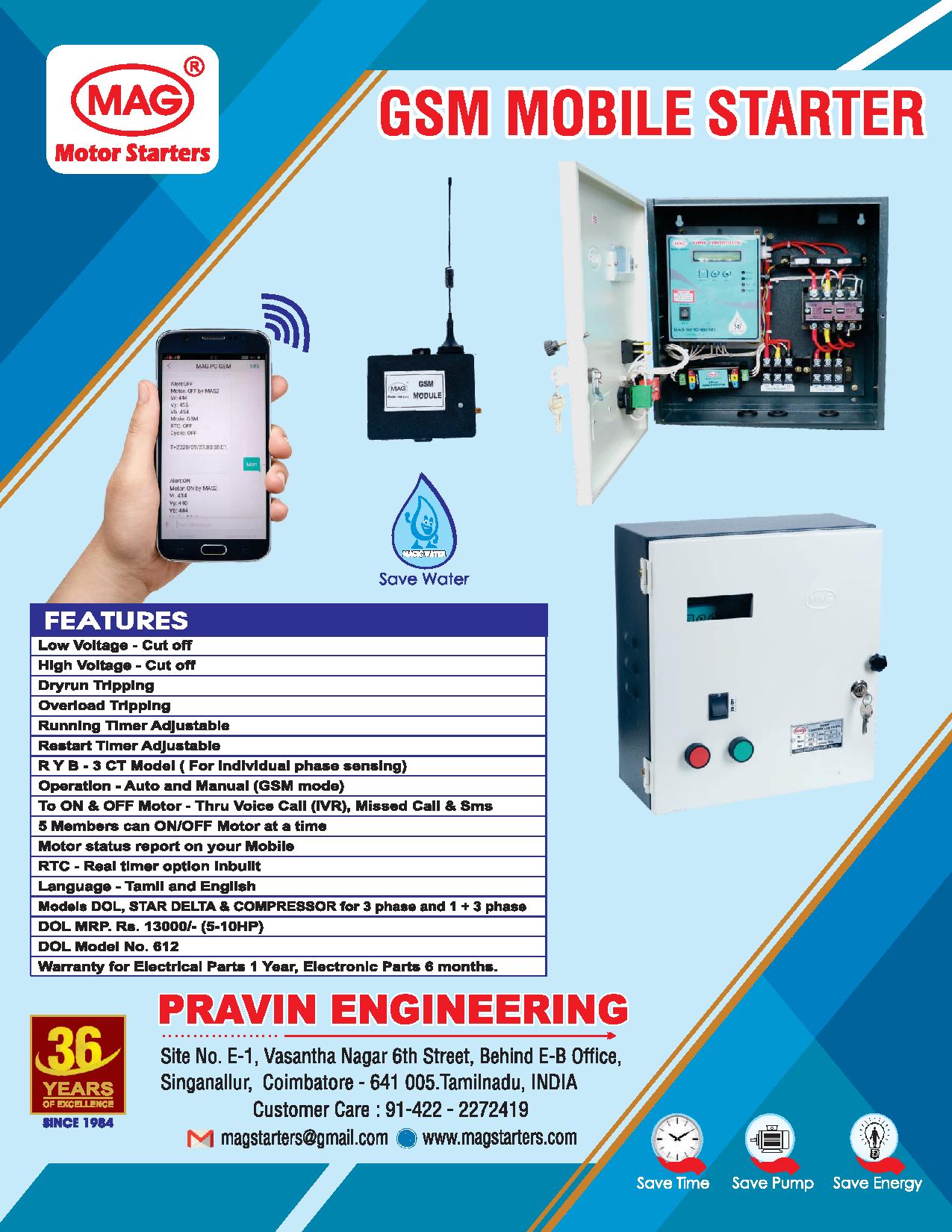 | G S M MOBILE STARTER DOL THREE PHASE MOBILE STARTER 10HP MAG GSM Mobile Starter Features Manual - To Operate Gsm Mobile Control Auto on Auto Off Low Voltage Settings High Voltage Settings DryRun Tripping... View product → |
 | PUMP CONTROLLER & WATER LEVEL MONITOR Pump Controller DOL - MAGIC UNIT ₹5500 Available Models • Single Phase - Submersible • Single Phase - Monoblock • Three Phase - DOL • Three Phase - Star Delta • One & Three Phase - DOL •... View product → |
Frequently asked questions
What actually differs between GSM and wired pump control?
GSM control sends commands through a mobile network, while wired control uses local switches, relays, and control cables. Both require local contactor, overload, short-circuit, isolator, and safety protection.
Which control method fits a pump site?
Choose GSM when the pump is distant, site access is difficult, and mobile coverage is reliable. Choose wired control when operators work near the pump or network availability is uncertain.
How do you prevent a remote command from becoming an unsafe start?
Route the GSM command through the starter’s control circuit and retain overload trips, short-circuit protection, isolation, and safety interlocks. Do not let the phone command bypass these protections.
What should installers verify before quoting a GSM pump starter?
Check mobile signal at the panel, power supply, pump rating, control-cable route, enclosure location, isolation method, interlocks, commissioning work, and recurring SIM or service costs.
Related products
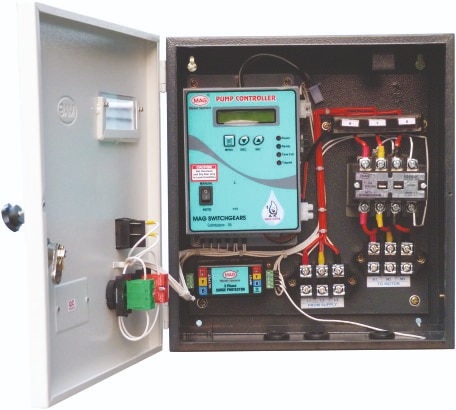 | MAGIC PUMP CONTROLLER PANEL Pump Controller Panel Three Phase - DOL 10 HP ₹10000 Available Models • Three Phase – DOL • Three Phase – Star Delta Features • Automatically runs the pump • Auto load settings for Overload and Dry Run... View product → |
 | Submersible Control Panel Single Phase Open Well Eco Control Panel 3HP ₹2000 Features: Ranging from 0.5 HP to 1.5 HP Suitable for Open-well Submersible Pumps With Run Capacitor MCB for Safe Tripping in Short-circuit Housed in... View product → |
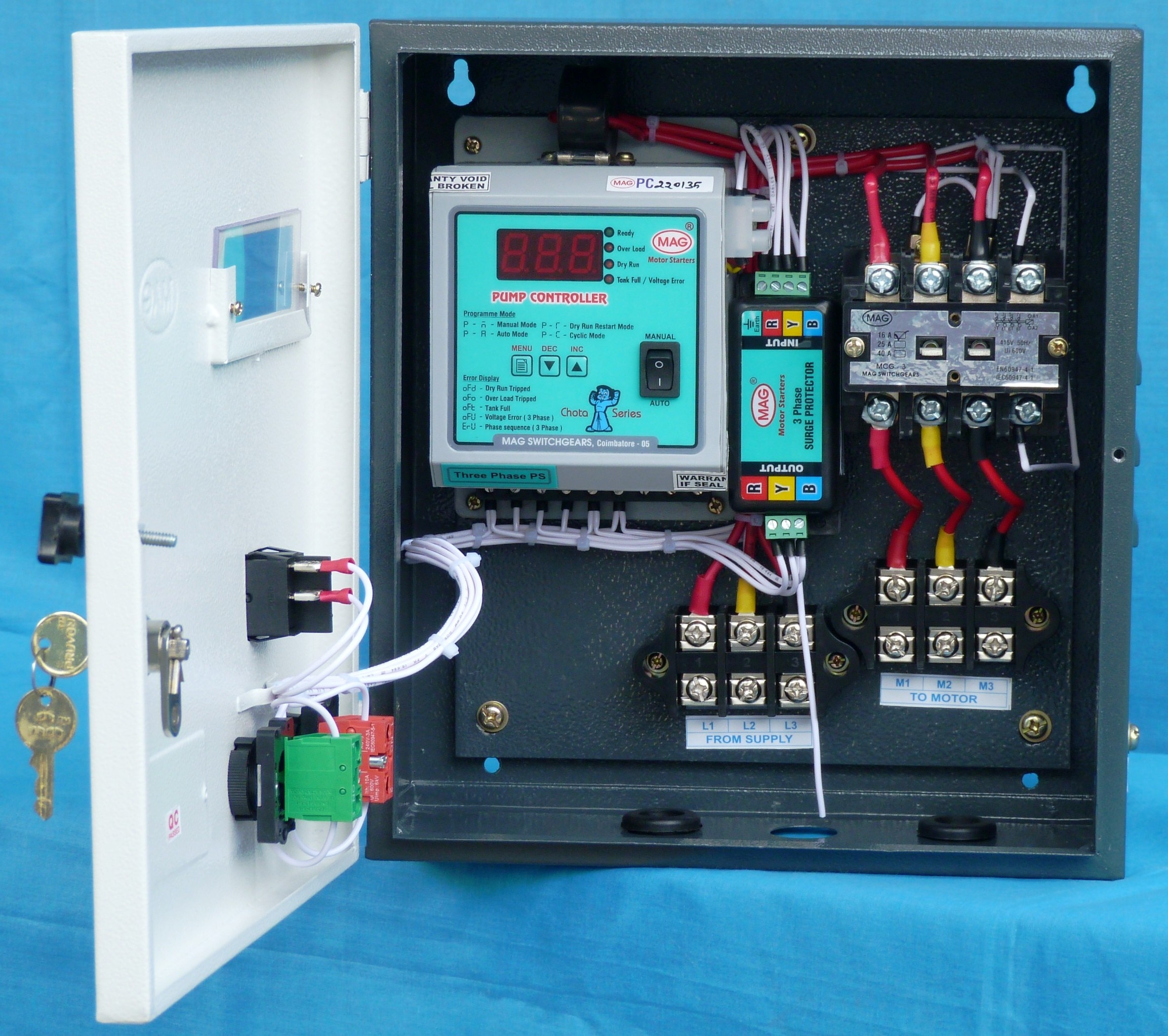 | Control Panel for Submersible Pumps CHOTA Pump Controller Panel 3 Phase DOL-10HP ₹8640 Available Models • Three Phase – DOL • Three Phase – Star Delta Features • Automatically runs the pump • Auto load settings for Overload and Dry Run... View product → |
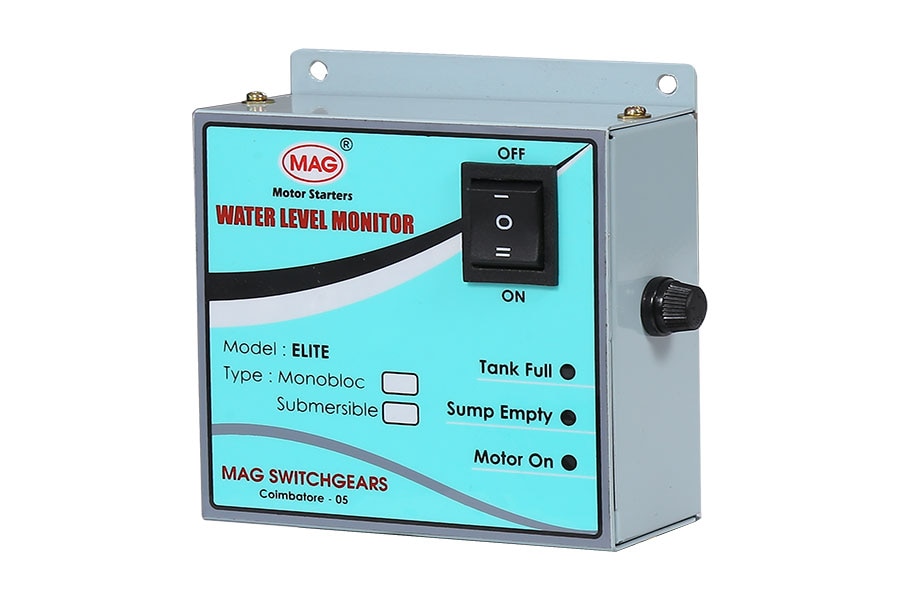 | Pump Controller for Single & Three Phase Water Level Monitor For Submersible Unit ₹1990 Available Models • Submersible • Monoblock Features • Easy to Install and Operate • LED indication for Easy reference • 2 Float Switch Model, One for... View product → |
Keywords