A 10 hp label does not prove that a portable starter will suit your motor, supply, cable, or pump duty. By checking the motor nameplate, starting method, protection needs, and site conditions, you can decide whether a mobile unit is appropriate or whether a fixed panel, star-delta arrangement, soft starter, or GSM control system is the better choice.
Key takeaways
- Match the starter to the motor nameplate current, voltage and phase sequence.
- Confirm your temporary supply can handle direct-on-line starting without excessive voltage drop.
- Set overload, dry-run and timer controls according to the pump’s real operating risks.
- Choose GSM control only when remote monitoring justifies its added installation and signal requirements.
What a mobile three-phase starter changes at the pump site
A mobile three phase motor starter is a portable control box that travels with a correctly sized pump. Its enclosure contains local start/stop controls, an isolation device, motor-duty contactor, overload protection, and phase-loss or phase-sequence protection, with a plug-and-socket connection and flexible cable for temporary installation.
A fixed starter is wired permanently to a wall, so relocating the pump requires new cabling and electrical work.
| Arrangement | What changes at the site | Best fit |
|---|---|---|
| Portable starter | Carry the enclosure, connect the plug, secure the cable, and operate locally | Changing pump locations |
| Fixed wall-mounted starter | Permanent wiring, fixed controls, and engineered site connections | One permanent pump installation |
Three phase mobile starter applications suit:
- Borewell pump operators shifting one pump between wells
- Agricultural irrigation users moving between fields or water points
- Construction and dewatering teams working at changing excavation sites
- Rental-pump operators and service technicians handling temporary jobs
- Businesses transferring one pump between several water sources
The arrangement saves installation time when the pump location changes, but portability does not correct an unsuitable motor rating, supply voltage, cable, or protection setting. A 10 hp label alone does not prove that the starter is safe: match the starter to the motor nameplate, starting method, current, and site supply before connecting it.
A permanent, frequently started, or unattended pump usually needs a fixed engineered panel instead.
Check the motor nameplate and temporary power connection before buying
Read the motor nameplate and measure the temporary supply before buying. A 10 hp motor equals approximately 7.46 kW mechanically, but that figure does not select the overload range, contactor, plug, cable, or protection setting.
1. Record the nameplate voltage, frequency, full-load current, duty, and connection arrangement, such as star or delta. Confirm that the three-phase supply has the same voltage and frequency, then check phase sequence; wrong sequence can reverse a centrifugal pump.
2. Measure voltage at the supply and again at the pump end while the motor runs. Pump users in Coimbatore should not assume that a 400–415 V connection remains adequate through a long temporary lead. Select conductor material and cross-section for the route length, installation method, ambient temperature, starting current, and acceptable voltage drop.
3. Before purchase, verify the socket or isolator rating, earthing, short-circuit protection, cable glands, strain relief, enclosure IP rating, and residual-current protection where applicable. The starter needs motor-rated switching and adjustable overload protection; an overload relay does not replace short-circuit protection.
For a 10 hp three phase mobile starter for pump users in coimbatore, reject any unit whose terminals, cable, or plug are rated only from the horsepower label. A wet site also needs water-resistant connections and a lockable isolator.
Confirm that direct-on-line starting will work on your supply
A 10 hp pump motor is suitable for direct-on-line (DOL) starting when the supply can withstand its starting demand without unacceptable voltage drop. A squirrel-cage induction motor can draw about 5–8 times its full-load current during acceleration, which can pull down voltage on a weak agricultural feeder or long temporary cable.
Check these three points before choosing a portable 10 hp pump starter:
- Compare the motor’s starting current, or 5–8 times its nameplate full-load current, with the supply capacity.
- Calculate cable voltage drop using conductor size, material, route length, and starting current.
- Measure line-to-line voltage at the starter and motor while the pump accelerates; a sharp dip, contactor chatter, slow acceleration, or tripping indicates that DOL is unsuitable.
| Option | What it changes | Conditions required |
|---|---|---|
| DOL | Applies full supply voltage and gives strong starting torque | Adequate supply capacity, cable, plug, isolator, and voltage stability |
| Star-delta | Reduces starting current but also reduces starting torque | Six accessible winding terminals, correct changeover wiring, suitable contactors, and enough torque to accelerate |
| Soft starter | Ramps voltage and current electronically | Correct selection for pump load, acceleration time, and start frequency |
Star-delta is not an automatic upgrade, and a soft starter cannot repair an undersized cable or weak supply. A portable 10 hp pump starter is a poor choice when voltage cannot hold during starting.
Match protection and timer settings to the pump’s actual risks
Set each adjustable function against the pump’s actual electrical and hydraulic risks; a generic 10 hp preset cannot do that safely.
1. Measure supply voltage and check the motor nameplate before setting low-voltage, high-voltage, phase-loss, and phase-sequence protection. A phase monitor handles faults that an overload relay cannot: two-phase running can overheat the remaining windings, while reversed sequence can reverse a centrifugal pump and stop proper delivery.
2. Set overload current from the motor nameplate full-load current and the protection manufacturer’s instructions, never from a generic 10 hp value. An incorrect setting causes nuisance trips or leaves the motor exposed.
3. Treat dry-run protection separately. An overload relay detects excessive current, but a pump running without water can draw less current and avoid tripping. Depending on the installation, three phase mobile starter applications may need under-current or power-factor sensing, level electrodes, pressure feedback, or flow feedback.
4. Use start-delay, running-timer, and restart-timer settings to control operation, not to hide faults. They do not detect every blocked-flow condition, seal failure, incorrect sensor arrangement, or damage from repeated starts.
5. Permit automatic restart only with fail-safe interlocks, correct wiring, and a proven water-level sensor. A restart timer is not a substitute for either protection or supervision.
Install and test the portable starter before leaving it unattended
Have a qualified installer commission the starter while the supply is isolated. A portable enclosure is not automatically suitable for wet outdoor service.
- Isolate the supply, lock out the isolator, and verify that all conductors are dead.
- Inspect the enclosure, cable, plug, glands, terminals, and strain relief. Reject damaged insulation, loose glands, or cracked covers.
- Secure the unit above splash and flood level. Keep plugs and terminals away from standing water, and prevent water tracking along cables into connections.
- Connect the protective earth first, then connect the phase conductors. Verify supply voltage, frequency, and phase sequence with suitable instruments.
- Confirm that the socket, plug, isolator, cable, and short-circuit protection carry the motor’s actual current and installation length.
- Set the overload from the motor nameplate full-load current and the protection manufacturer’s instructions, not from the 10 hp label.
- Start briefly and check rotation before placing the pump into normal service. Incorrect phase sequence can reverse a centrifugal pump and stop or reduce pumping.
- Test phase-loss protection and dry-run sensing under controlled conditions. Phase loss can leave the motor running on two phases, overheating the remaining windings; overload protection alone may not detect dry running.
- Use manual reset for unattended equipment when automatic restarting could endanger people, equipment, or the water system.
Choose between a portable unit, fixed panel, and GSM control
Choose a portable unit if you move one correctly sized pump between borewells, irrigation points, construction dewatering locations, or temporary transfer jobs. Choose a fixed panel for permanent installation, frequent starting, complex level or pressure sequencing, or unattended operation needing engineered interlocks.
| Option | What it means | When it applies |
|---|---|---|
| Portable unit | A movable enclosure with local switching and pump protection | One pump moves between sites and the supply connection changes |
| Fixed panel | A permanent, engineered control assembly with interlocks | The pump stays installed or operates through a defined automatic sequence |
| GSM mobile starter | Remote start, stop, status, and fault communication | You need remote access and have dependable cellular service |
A GSM mobile starter alternative depends on SIM validity, network coverage, antenna placement, controller power, and fail-safe settings. It cannot replace short-circuit, overload, phase-loss, or dry-run protection. If cellular service is unreliable, retain local controls and a safe manual bypass.
MAG STARTERS (PRAVIN ENGINEERING) - 08048068970 can help Coimbatore buyers compare motor ratings, enclosure arrangements, and protection requirements instead of choosing by the 10 HP label alone.
Related product
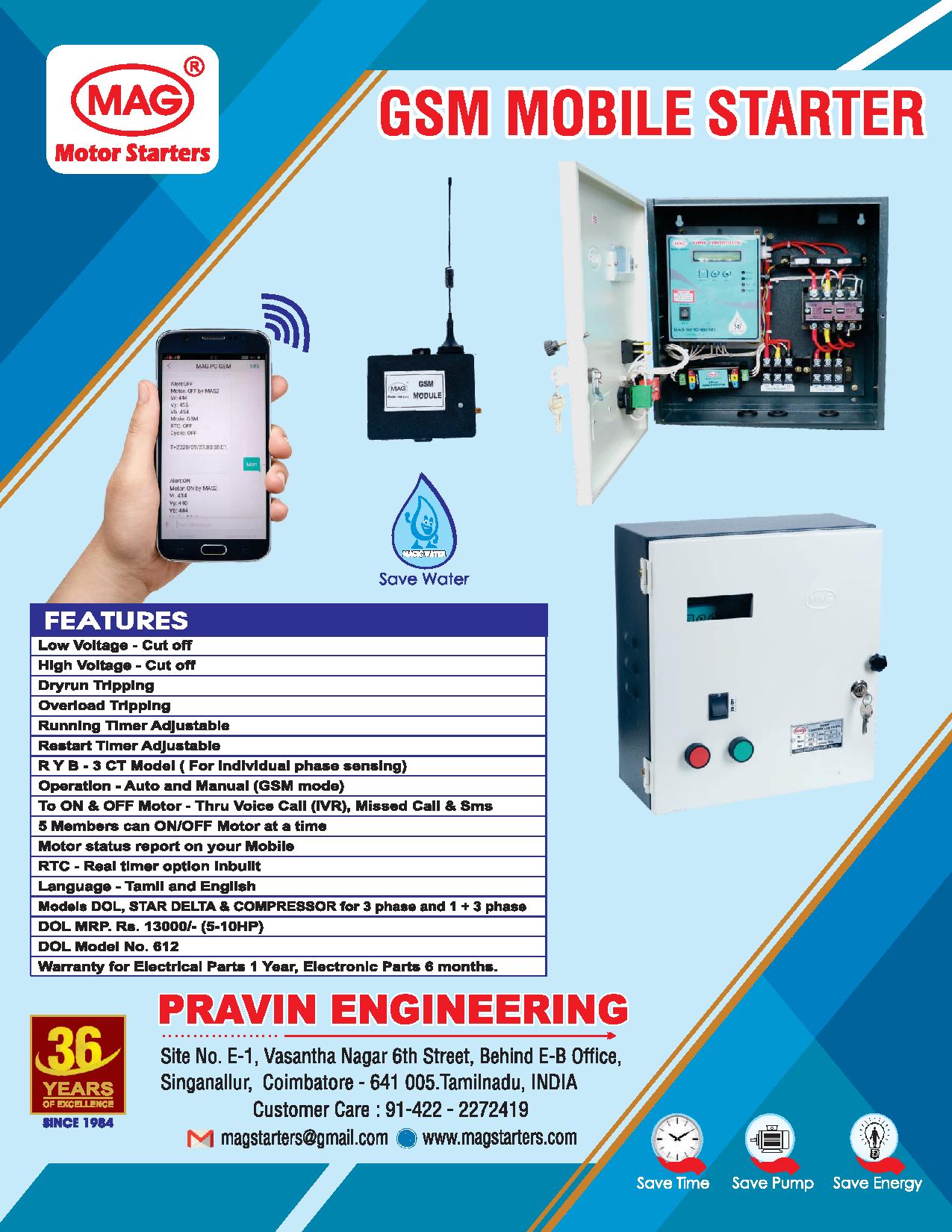 | G S M MOBILE STARTER DOL THREE PHASE MOBILE STARTER 10HP MAG GSM Mobile Starter Features Manual - To Operate Gsm Mobile Control Auto on Auto Off Low Voltage Settings High Voltage Settings DryRun Tripping... |
Frequently asked questions
What does a mobile three-phase starter change at a pump site?
It provides portable local start and stop control, motor isolation, overload protection, and phase protection for a correctly sized pump without requiring a permanent panel installation.
What should you check before buying a portable 10 HP pump starter?
Read the motor nameplate for rated voltage, full-load current, frequency and connection, then verify the temporary supply, plug, socket, cable and earthing arrangement.
Will a 10 HP motor always work with direct-on-line starting?
No. Confirm that the supply transformer, generator or feeder can handle the motor’s starting current without unacceptable voltage drop or nuisance tripping.
When is a fixed panel or GSM starter a better choice?
Use a fixed panel for a permanent installation with dedicated wiring. Choose GSM control when remote starting, status alerts or fault visibility justify the required signal, power and configuration.