A GSM starter is useful only when remote pump control solves a real operating problem without weakening local safety controls. You will be able to judge the network, motor, protection, installation, and ongoing-cost requirements before deciding whether remote starting is better than a local panel, timer, or PLC system.
Key takeaways
- Use an interposing relay or contactor; never switch a three-phase motor directly through the GSM relay.
- Test mobile signal strength at the pump room before depending on remote starting.
- Buy remote GSM control when site visits, water shortages, or downtime cost more than the system.
- Approve a 10 HP DOL starter only after checking motor current, supply voltage, and starting conditions.
What happens when someone starts the pump by phone?
1. An authorised user sends an SMS or places a call to the GSM module. The module checks the caller’s number, command format, and permission list before energising an interposing relay or correctly rated contactor coil. The GSM relay must not switch the three-phase motor directly.
2. The control circuit then checks the Manual-Off-Auto selector, emergency stop, overload-trip status, phase-failure and phase-sequence protection, and the tank or sump level switch. Add dry-run, pressure, or flow interlocks where the pump requires them. A remote pump starter for commercial facilities must block the start when any interlock is open.
3. A reply saying “command received” proves only that the module accepted the request. Require a second confirmation from the contactor’s auxiliary contact, plus a fault status, so you know whether the contactor pulled in and whether the motor circuit remained healthy. Record each event with the time, authorised number, command, result, and fault.
4. Specify authenticated commands, authorised-number management, command timeouts, and duplicate-message handling. SMS delivery can be delayed, repeated, or lost, so a sent message is never proof that the pump ran. After overload, emergency stop, maintenance isolation, or power restoration, require restart inhibition until a person resets the fault or the programmed safe conditions return.
GSM adds remote command and monitoring; it does not replace short-circuit protection, a correctly rated contactor, an overload relay, or a local lockout point. Test local and remote control, feedback, interlocks, and recovery before approving the installation.
Will the mobile network work reliably at your pump room?
A phone showing bars outside the building does not prove that a GSM three phase mobile starter for commercial pumps in Coimbatore will communicate from the pump room. Test the installed position, then specify the fallback when communication fails.
Ask the supplier to document:
- Cellular technology, frequency bands, expected service life, and whether the modem is 2G-only.
- SIM format: standard SIM, micro-SIM, or another type; tested local operators at the panel location.
- Signal strength inside the electrical room, basement, metal enclosure, or pump house, not outside on a phone.
- Antenna type, cable length, mounting position, surge protection, and the effect of the panel enclosure.
- Acknowledgement timeout, event history, and local control mode.
- SIM recharge cost, cellular service cost, modem replacement risk, and the procedure for a failed SIM.
| Condition | Operational risk | Required design response |
|---|---|---|
| Weak signal, congestion, or delayed SMS | Start command arrives late, twice, or not at all | Reject duplicates, report timeout, and record each event |
| Depleted balance or SIM failure | Remote control and alerts stop | Show a local fault and retain local automatic control |
| Total network outage | No remote command or acknowledgement | Define whether the pump holds its last state, follows local automatic control, or stops safely |
| 2G-only modem | Service may not suit the installation’s full life | Confirm future network support before purchase |
Require local Manual-Off-Auto operation. A sent SMS is not proof of running; demand contactor feedback and fault history. Test signal loss, SIM interruption, delayed messages, and mains restoration before approval.
When does remote GSM control earn its cost?
Remote GSM control earns its cost when a missed start causes a costly visit, water-level problem, or process interruption. Compare the five choices before paying for communication hardware:
| Option | Main benefit | Best fit | Limitation |
|---|---|---|---|
| Local manual starting | Simple, low-cost control | One pump beside staff | Someone must travel to start it |
| Timer | Predictable scheduled runtime | Routine filling cycles | Cannot respond to faults or changing demand |
| Conventional auto-start panel | Automatic operation from level or pressure | Local unattended pumping | Limited remote visibility |
| Wired PLC or SCADA | Detailed monitoring and control | Large sites with existing networks | Higher installation and configuration cost |
| GSM starter | Remote commands and fault alerts | Distributed or distant pump rooms | SIM, network, and maintenance costs |
The three phase GSM motor starter benefits become measurable when it avoids operator trips, starts a pump outside staffed hours, reports overload or phase faults, limits runtime with schedules, and responds quickly to a falling tank level or process stoppage.
A mobile pump starter for industries still needs local Manual-Off-Auto control, isolation and lockout, level and dry-run interlocks, and a safe response to communication failure.
Budget for SIM recharge, cellular dependency, command latency, false starts, electrical maintenance, configuration management, and failure investigation. A GSM starter is harder to justify for one pump beside a continuously staffed control room, where a wired panel, timer, alarm, or basic auto-start system may provide most of the value.
Estimate avoided visits and avoided downtime, then compare that value with installation, communication, maintenance, and failure-response costs. If the savings do not exceed those costs, retain local automation instead.
Is a 10 HP DOL starter suitable for your motor and pump?
A 10 HP label does not prove that a DOL starter suits your motor or pump. Require the motor nameplate voltage, frequency, full-load current, starting current, duty, acceleration time, and starts per hour, then compare them with:
- Contactor current and duty rating
- Overload-relay range and trip class
- Upstream breaker or fuse and short-circuit coordination
- Control voltage
- Enclosure rating for the pump-room environment
DOL starting commonly draws five to eight times full-load current. That inrush can cause voltage dips with a weak supply or long cable run, and a high-inertia pump may fail to accelerate.
| Method | Starting behaviour | Choose it when |
|---|---|---|
| DOL | Full inrush; full starting torque | The supply and motor circuit tolerate the starting current |
| Star-delta | Theoretical line current and torque fall to about one-third of DOL | The pump accelerates at reduced torque |
| Soft starter or VFD | Controls current and acceleration | DOL causes dips, the utility limits starting current, the motor exceeds 10 HP, or the pump has high inertia |
Star-delta will not suit a pump that needs high breakaway torque. Use the motor manufacturer’s acceleration limit when deciding.
Overload and phase protection protect the motor, not the pump process. Dry-run, low-pressure, flow, tank-level, and suction protection need current-based algorithms or separate sensors.
Select overload trip class 10A, 10, 20, or 30 against actual acceleration time and permissible locked-rotor duration. Do not choose a higher class merely to hide nuisance trips; a stalled motor can remain exposed too long.
What should you demand before approving the purchase?
Do not approve on a GSM feature list alone. Require a signed proposal that identifies the motor, protection, communications, enclosure, and recovery behaviour, then witness commissioning at the pump site.
- State the motor-current range, DOL, star-delta, soft-starter or VFD method, contactor and overload ratings, short-circuit coordination, control voltage, and cable-gland sizes.
- Specify cellular technology, frequency bands, SIM format, compatible operators, tested signal strength inside the pump room, antenna type, cable length, mounting, and surge protection.
- State IP rating, operating-temperature range, earthing method, condensation control, UV resistance, and lightning protection.
- Select one power-failure action: restart, remain stopped, or restart after a programmed delay. Inhibit restart after overload, phase failure, emergency stop, or maintenance isolation.
- Test local start and stop, authorised remote commands, rejected commands, acknowledgement timing, contactor feedback, signal loss, SIM interruption, mains failure and restoration, overload, phase loss, dry-run or level interlock, and recovery behaviour.
Ask for commissioning records, fault-diagnosis support, spares, warranty terms, and any panel modifications. A gsm starter supplier in coimbatore, including MAG STARTERS (PRAVIN ENGINEERING) - 08048068970, should be judged against these records rather than location.
| Option | Approve when | Reject when |
|---|---|---|
| GSM control | Remote intervention prevents measurable travel or downtime, with safe fallback proven | Network or lifecycle costs exceed the benefit |
| Local, timer, or PLC | The site has reliable local access or wired control is practical | Remote response is operationally critical |
| Any DOL starter | Inrush, supply strength, and acceleration suit DOL | Voltage dips, high inertia, or protection limits require another method |
Related product
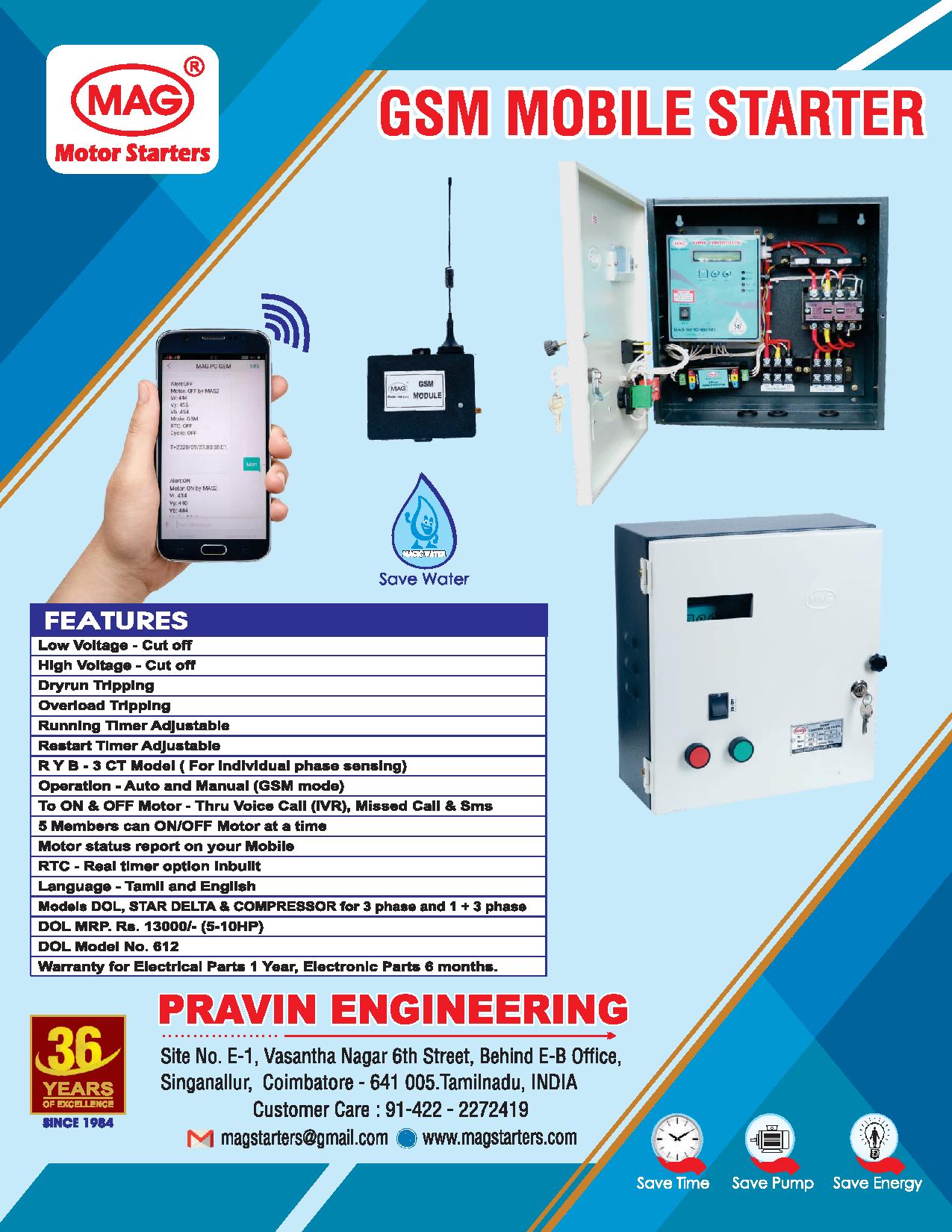 | G S M MOBILE STARTER DOL THREE PHASE MOBILE STARTER 10HP MAG GSM Mobile Starter Features Manual - To Operate Gsm Mobile Control Auto on Auto Off Low Voltage Settings High Voltage Settings DryRun Tripping... |
Frequently asked questions
What happens when someone starts the pump by phone?
The GSM module verifies the authorised caller or SMS command, then energises an interposing relay or correctly rated contactor coil. It must not switch the three-phase motor directly.
Will the mobile network work reliably at the pump room?
Check signal strength inside the pump room using the intended network and SIM. Test calls, SMS delivery, and command response at different times before installation.
When does remote GSM control earn its cost?
It earns its cost when staff travel frequently to operate the pump, water supply interruptions cause losses, or the facility needs control outside working hours.
Is a 10 HP DOL starter suitable for my motor and pump?
Confirm the motor nameplate voltage, full-load current, phase arrangement, contactor rating, overload range, starting current, and local utility limits before choosing DOL starting.
What should you demand before approving the purchase?
Request a wiring diagram, protection details, manual override, overload and phase-failure protection, dry-run provisions, authorised-number controls, SIM requirements, warranty terms, and commissioning tests.