

A thermal relay that will not reset, trips immediately, or trips again after several minutes can indicate anything from a hot bimetal element to phase loss, a failed star-to-delta changeover, or a seized pump. By following a safe fault-finding order, checking the relay setting against the motor nameplate, and testing the control sequence, you can separate a reset problem from a motor, supply, or load fault.
Key takeaways
- Isolate and lock out the panel before pressing the thermal relay reset.
- Match relay current settings to the motor nameplate full-load current.
- Check whether trips occur during starting, transfer, or steady delta running.
- Test contactor timing, phase current, and automatic reset settings before restarting.
Start with trip timing and safe isolation
A trip during starting, at star-to-delta transfer, or several minutes into delta points to different faults. Before any star delta motor overload reset, switch off, isolate, lock out the supply, and prove the circuit is dead with an approved tester. Do not keep pressing reset on an energised panel.
| Timing | Likely cause | What confirms it |
|---|---|---|
| During starting | Pump or compressor needs more torque than star starting provides; relay setting or acceleration time is wrong | Motor fails to reach speed while drawing high current |
| At transfer | Timer, contactor, interlock, coil, or control-voltage fault | Motor remains in star, or star and delta contactors overlap |
| After several minutes in delta | Genuine sustained overload, seized pump, dry running, phase loss, low voltage, or voltage imbalance | Three-phase current and voltage readings identify the abnormal condition |
Use this star delta relay troubleshooting order:
- Record the trip indicator and inspect burnt terminals, loose wires, damaged contactors, and unusual smell before touching the reset.
- Let an overheated bimetal element cool. Check whether the reset mechanism moves freely; a jammed mechanism can mimic an electrical fault.
- A qualified person should measure current in all three phases while the motor runs in delta, then compare each reading with the nameplate full-load current. One-phase testing can miss phase loss or severe imbalance.
- Measure phase-to-phase voltage at the motor terminals and verify the motor actually changes from star to delta.
- Test the overload auxiliary contact and contactor coil circuit electrically. A button that moves does not prove the relay has reset; an open auxiliary path, faulty seal-in circuit, or relay set below running current can keep the starter tripped.
Why the thermal relay will not reset
A thermal relay will not reset while its bimetal element is still overheated, its reset mechanism is jammed, or its auxiliary contact remains open. A contactor that is still energised can also keep the control circuit in a trip condition.
Use this star-delta motor overload reset sequence:
- Isolate the incoming supply, confirm the motor cannot start, and inspect the relay’s trip indicator. Do not force the reset button while the panel is energised.
- Allow the relay to cool for its specified reset time, then check whether the button moves and latches. A stiff button indicates mechanical damage or contamination.
- Inspect the overload auxiliary contact and its terminals. With a meter, verify that the contact changes state when you press reset; do not judge success from button movement alone.
- Trace the control circuit through the stop button, overload contact, seal-in contact, timer, interlocks, and main, star, and delta contactor coils. Find an open wire, incorrect timer terminal, low control voltage, or a coil that remains energised.
- Confirm the motor changes from star to delta. A failed delta coil or interlock leaves the motor in star, causing high current and another trip.
- After safe testing, measure all three phase currents in delta and compare them with the nameplate value. Check phase-to-phase voltage and loose terminals; phase loss, low voltage, imbalance, a seized pump, or dry running can cause genuine trips.
- Verify the relay setting and location. A line-connected relay uses nameplate current; one inside the delta loop uses about 0.58 times that current. This is the essential star-delta relay troubleshooting check before replacing the relay.
Set the relay for the actual ten-hp motor
Use the motor nameplate full-load current, not a generic ten-hp chart. A 10 hp motor is about 7.46 kW, but two motors with the same rating can draw different current because of voltage, efficiency, power factor, and winding design.
A 380–415 V motor may show roughly 14–17 A, but its printed nameplate value controls the setting.
| Relay location | Setting method | Example with 16 A nameplate current |
|---|---|---|
| Line circuit | Set to the motor nameplate full-load current | 16 A |
| Inside delta loop | Set to about 0.58 times the nameplate current | 9.3 A |
Confirm the relay location by tracing its current path with power isolated. Applying the 0.58 factor to a line-connected relay makes it trip below the motor’s normal load; setting a delta-loop relay to 16 A weakens overload protection. Use the nearest adjustment value on the relay scale without exceeding the calculated requirement.
For a ten hp star delta relay reset in Coimbatore, check the nameplate voltage and current against the starter wiring before changing the dial. The motor must have six accessible winding terminals and a winding arrangement suitable for delta operation at the supply voltage.
A motor intended to run in star at line voltage can suffer excessive winding voltage if connected for delta, causing rapid tripping or damage. After setting, measure each line current while the motor runs steadily in delta and investigate imbalance instead of raising the setting.
Test the star-to-delta sequence and motor current
Measure all three phase currents in delta and compare them with the motor nameplate current; one-phase testing can miss phase loss, imbalance, or a loose termination. Record whether the trip occurs during starting, at star-to-delta transfer, or after several minutes in delta.
1. Isolate the supply, inspect the overload indicator, and check for burnt terminals, loose lugs, damaged contactor tips, or a jammed mechanism. Confirm the motor has six accessible winding terminals and the correct voltage arrangement for delta operation.
2. With power restored by a qualified technician, check phase-to-phase voltage at the starter and motor terminals. Unequal voltage, a missing phase, or low control voltage points to the supply, fuse, cable, or terminal connections rather than a simple overload.
3. Observe the sequence: the main and star contactors must close for starting, the timer must open the star circuit, and the delta contactor must close without overlap. If the motor remains in star, inspect timer terminals, its contact, the delta coil, auxiliary-contact path, and electrical and mechanical interlocks.
4. Measure each phase current after delta closes. High, unequal current indicates phase loss, winding trouble, incorrect connections, or a loose terminal; balanced high current points to excessive pump load, a seized pump, blocked discharge, or incorrect relay setting.
5. If current and voltage are correct but trips continue, test motor insulation and winding resistance with power isolated, then inspect the pump for bearing, impeller, or dry-running faults. This is the core of star-delta relay troubleshooting, including any ten-hp star-delta relay reset in Coimbatore.
Choose reset and maintenance practices that prevent repeat trips
Use manual reset for a ten-hp pump starter while you investigate the trip. A star delta motor overload reset should not restore power until you have checked the motor current, supply phases, pump condition, and contactor sequence.
Automatic reset is unsafe when an unexpected restart could injure someone, catch a seized pump, or repeatedly energise a dry-running motor.
| Manual reset | Stops the motor after a trip and requires inspection | Fault finding, attended installations, uncertain overload causes |
|---|---|---|
| Automatic reset | Re-energises the control circuit after the relay cools | Only where the area is safe and restart permissives prevent damage |
| Automatic reset with safeguards | Allows controlled restart after checks | Unattended pumps with low-water, phase-failure, and short-cycle protection |
For automatic thermal relay maintenance in coimbatore, isolate and lock out the panel before checking:
- Remove dust and moisture; look for corrosion, overheated terminals, cracked insulation, oil contamination, and blocked ventilation slots.
- Operate the relay’s trip and reset mechanism, then verify the auxiliary contact changes state electrically and permits the contactor coil to energise.
- Measure running current in all three phases and compare it with the nameplate and relay setting. Recheck the setting after replacing the motor, relay, contactor, or starter.
- Inspect the star-delta timer, electrical interlocks, terminals, and control wiring if the reset button moves but the motor does not restart.
A qualified Coimbatore motor-control technician should test voltage imbalance, phase loss, transition timing, and insulation before returning an unattended pump to service. MAG STARTERS (PRAVIN ENGINEERING) - 08048068970 can help match a replacement panel or relay to the nameplate current and actual star-delta wiring rather than a generic ten-hp chart.
Related products
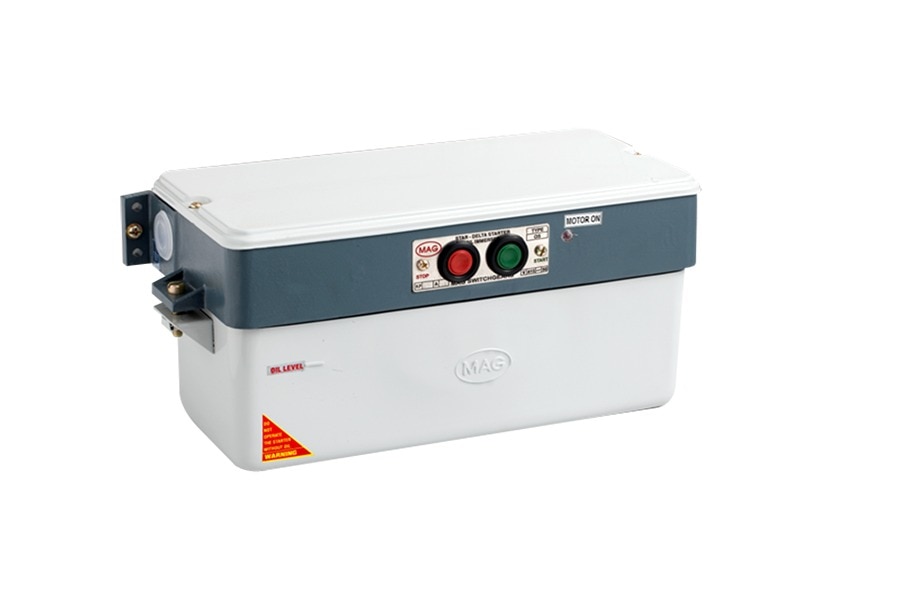 | OIL IMMERSED MOTOR STARTERS STAR DELTA - AUTOMATIC THERMAL RELAY 10HP ₹12890 • Ranging from 5 HP to 50 HP • Contacts made of Electrolytic Copper with Double Break System, Ensure long life and Better Conductivity • No Volt coil... |
 | Oil Immersed Starter CODE NO 033 Oil Immersed Starter Star Delta - Handle Type 10 HP ₹7710 • Ranging from 5 HP to 40 HP • Electrolytic Copper Contacts with Double Break System, Ensure long life and Better Conductivity • Changeover from Star... |
Frequently asked questions
Why will a star-delta thermal relay refuse to reset?
Common causes include an active overload, relay temperature above its reset threshold, incorrect current settings, a control-circuit fault, or a mechanical trip mechanism that needs inspection.
How should you set a thermal relay for a 10 HP motor?
Read the motor nameplate full-load current and set the relay according to the manufacturer’s specified protection arrangement. Do not estimate the setting from horsepower alone.
What does a trip at star-to-delta transfer indicate?
Inspect transfer timing, contactor interlocking, phase sequence, loose terminals, and current spikes. A poorly timed or incomplete changeover can produce a high-current transition.
How do you prevent repeat star-delta relay trips?
Record trip timing, measure all three delta currents, tighten and inspect connections, clean the panel, verify overload settings, and replace damaged contactors or relays.